A Levels Chemistry (9701)•9701/11/O/N/24
Explanation
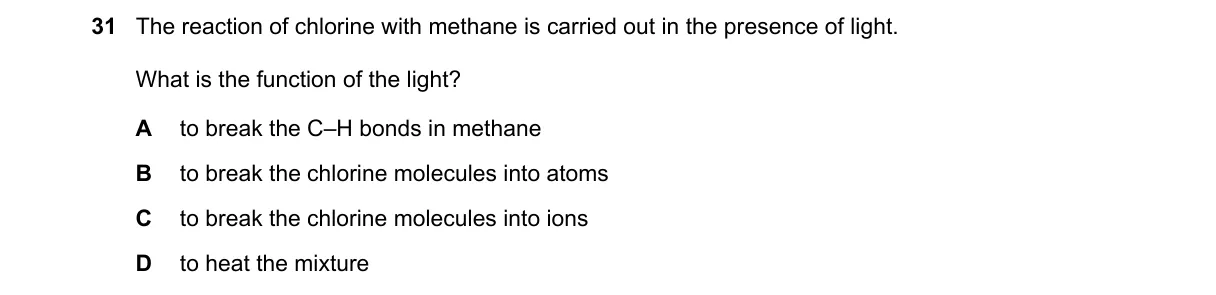
Light initiates free radical chlorination
Steps:
- Identify the reaction as free radical substitution between Cl₂ and CH₄.
- Recall that light provides energy for homolytic bond fission to start the chain.
- Note Cl-Cl bond energy (243 kJ/mol) is lower than C-H (413 kJ/mol), so light breaks Cl₂ first.
- Confirm this generates Cl• radicals, propagating the reaction.
Why B is correct:
- In free radical halogenation, UV light causes homolytic cleavage of the Cl-Cl bond (Cl₂ → 2Cl•), initiating the chain reaction as defined by the mechanism.
Why the others are wrong:
- A: Light lacks sufficient energy to directly break strong C-H bonds; radicals attack them instead.
- C: Not enough information.
- D: Light acts photochemically, not thermally; heat alone would not initiate radicals efficiently.
Final answer: B
Topic: Hydrocarbons
Practice more A Levels Chemistry (9701) questions on mMCQ.me