A Levels Chemistry (9701)•9701/11/O/N/24
Explanation
Acid-Base Behavior and Geometry of Ammonia and Ammonium
Steps:
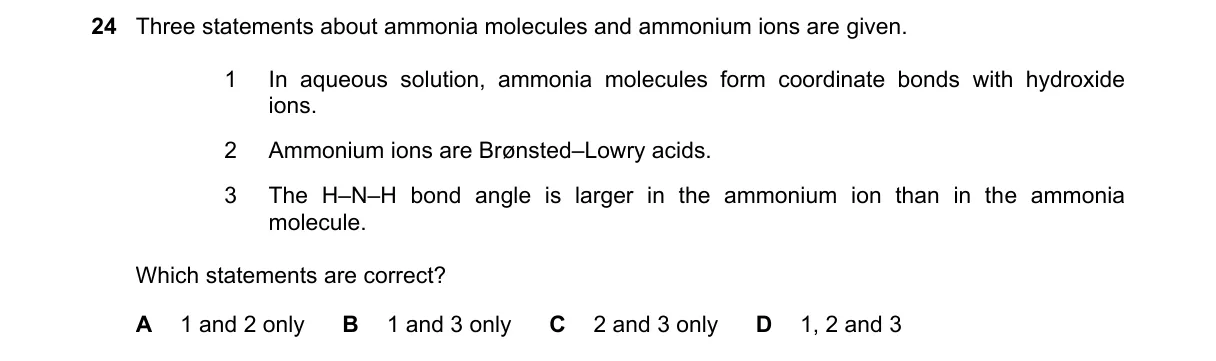
- Statement 1: Ammonia (NH₃) acts as a base in water by accepting a proton (NH₃ + H₂O → NH₄⁺ + OH⁻), forming ammonium ions, not coordinate bonds with hydroxide ions.
- Statement 2: Ammonium ions (NH₄⁺) donate a proton (NH₄⁺ → NH₃ + H⁺), fitting the Brønsted-Lowry acid definition as a proton donor.
- Statement 3: In NH₃, the lone pair causes trigonal pyramidal shape with H-N-H angle ~107°; in NH₄⁺, tetrahedral geometry gives 109.5° angle, so larger in ion.
- Overall: Statements 2 and 3 hold, but 1 does not, selecting option C.
Why C is correct:
- Matches Brønsted-Lowry definition (proton donation for NH₄⁺) and VSEPR theory (tetrahedral NH₄⁺ vs. pyramidal NH₃ geometry).
Why the others are wrong:
- A: Includes false statement 1 about coordinate bonds.
- B: Includes false statement 1, excludes correct statement 2.
- D: Includes false statement 1.
Final answer: C
Topic: Nitrogen and sulfur
Practice more A Levels Chemistry (9701) questions on mMCQ.me