A Levels Chemistry (9701)•9701/11/O/N/24
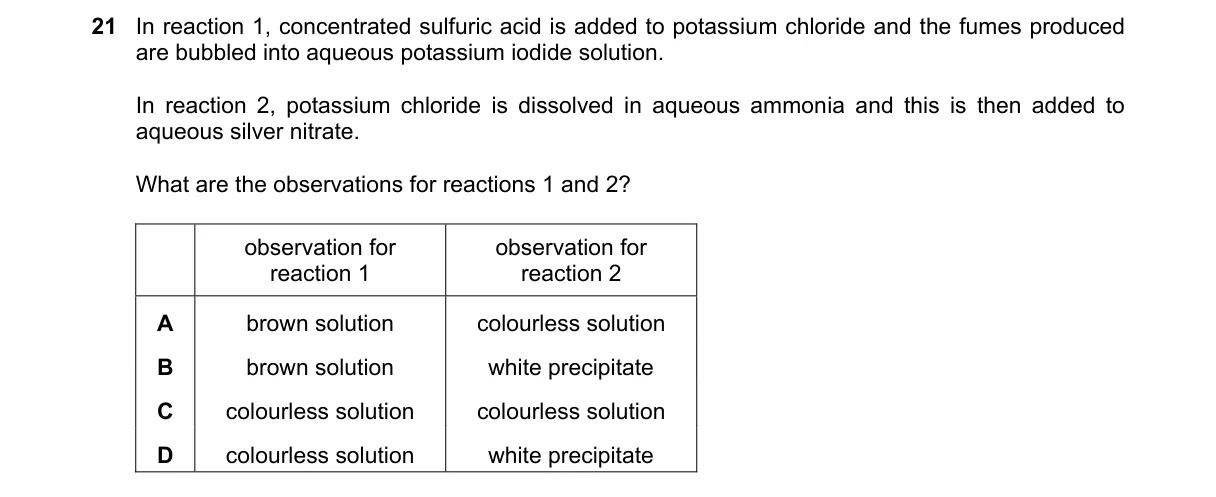
Explanation
Redox and precipitation observations in halide reactions
Steps:
- Reaction 1: Conc. H₂SO₄ + KI produces I₂ and SO₂ gas (fumes); SO₂ is colorless.
- SO₂ bubbled into KIO₃ reduces iodate to iodide: IO₃⁻ + 3SO₂ + 3H₂O → I⁻ + 3SO₄²⁻ + 6H⁺, forming colorless solution.
- Reaction 2: KCl (in aq. NH₃) + AgNO₃ yields AgCl via Ag⁺ + Cl⁻ → AgCl.
- AgCl forms white precipitate, observable before potential dissolution in NH₃.
Why C is correct:
- Reaction 1 ends with colorless I⁻/SO₄²⁻ solution per the reduction equation; reaction 2 gives white AgCl(s) per solubility rules (Ksp = 1.8 × 10⁻¹⁰).
Why the others are wrong:
- A: Reaction 1 yields colorless, not brown, solution (no free I₂ persists).
- B: Reaction 1 yields colorless, not brown, solution.
- D: Reaction 2 yields white ppt, not colorless solution.
Final answer: C
Topic: Group 17
Practice more A Levels Chemistry (9701) questions on mMCQ.me