A Levels Chemistry (9701)•9701/13/O/N/23
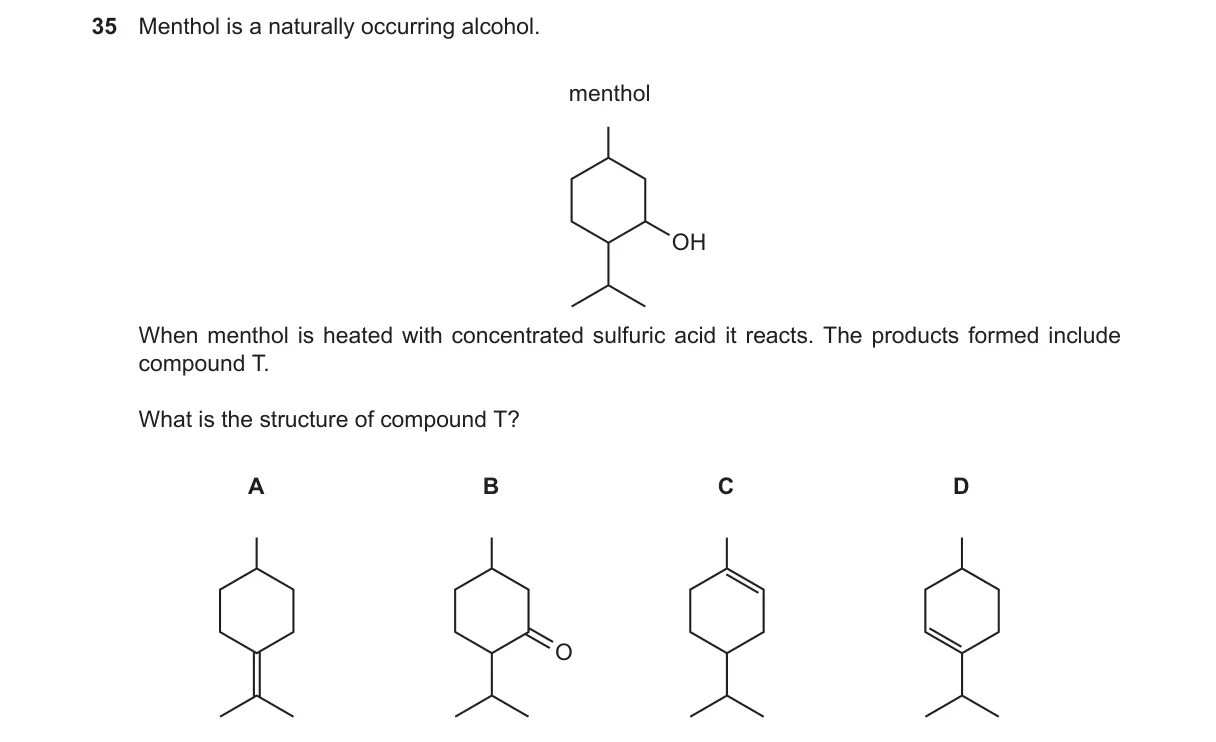
Explanation
Dehydration of menthol forms an alkene via E1 mechanism Steps:
- Protonate the hydroxyl group of menthol with H2SO4 to form a good leaving group.
- Loss of water from the secondary alcohol yields a secondary carbocation at the carbon originally bearing the OH.
- The carbocation undergoes deprotonation from an adjacent carbon, following Zaitsev's rule to favor the more substituted alkene.
- The major product is the trisubstituted alkene with the double bond between carbons 1 and 2 in the menthol numbering.
Why D is correct:
- D shows the trisubstituted cyclohexene with isopropyl at C3 and methyl at C6, matching Zaitsev's rule for the most stable alkene from menthol dehydration.
Why the others are wrong:
- A: Depicts a disubstituted alkene, less stable and minor product.
- B: Shows incorrect double bond position, violating elimination from the carbocation site.
- C: Represents an unrearranged primary alkene, thermodynamically unfavorable.
Final answer: D
Topic: Hydroxy compounds
Practice more A Levels Chemistry (9701) questions on mMCQ.me