A Levels Chemistry (9701)•9701/13/O/N/23
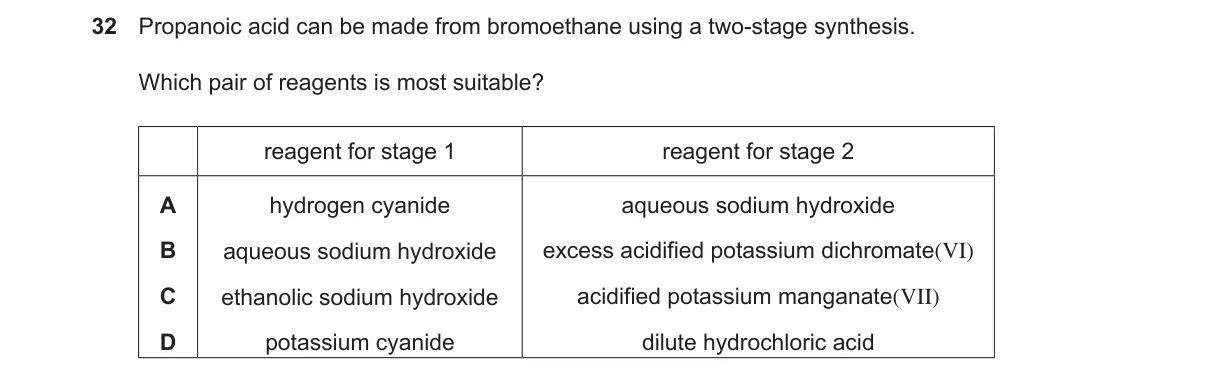
Explanation
Nucleophilic substitution followed by nitrile hydrolysis
Steps:
- Bromoethane (CH₃CH₂Br) undergoes SN2 reaction with CN⁻ from KCN to form propanenitrile (CH₃CH₂CN).
- Propanenitrile hydrolyzes under acidic conditions with dilute HCl to yield propanoic acid (CH₃CH₂COOH) and NH₄⁺.
Why D is correct:
- KCN supplies CN⁻ for substitution on primary alkyl halide (SN2 favored), and dilute HCl provides H⁺/H₂O for nitrile hydrolysis to carboxylic acid (R-CN + 2H₂O + HCl → R-COOH + NH₄Cl).
Why the others are wrong:
- A: Aqueous NaCN forms nitrile, but acidified K₂Cr₂O₇ oxidizes alcohols, not nitriles directly to acids.
- B: Aqueous NaOH substitutes to ethanol (CH₃CH₂OH), oxidized by K₂Cr₂O₇ to ethanoic acid (2 carbons), not propanoic.
- C: Ethanolic NaOH causes E2 elimination to ethene, oxidized by KMnO₄ to CO₂, not propanoic acid.
Final answer: D
Topic: Organic synthesis
Practice more A Levels Chemistry (9701) questions on mMCQ.me