A Levels Chemistry (9701)•9701/12/O/N/23
Explanation
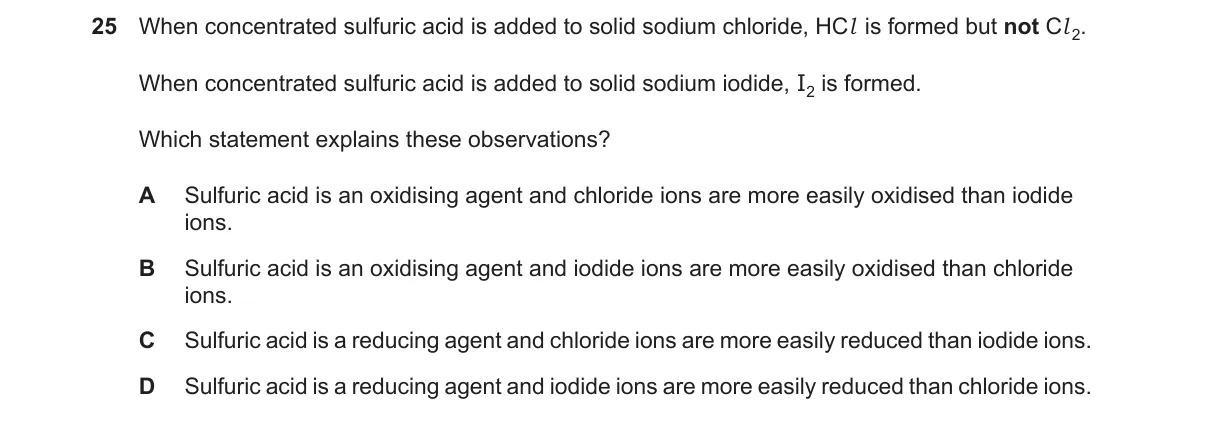
Sulfuric acid oxidizes iodide but not chloride
Steps:
- Concentrated H2SO4 reacts with NaCl to form HCl, indicating no oxidation of Cl⁻.
- With NaI, I₂ forms, showing oxidation of I⁻ to I₂ by H2SO4.
- H2SO4 acts as an oxidizing agent in these reactions.
- Standard reduction potential for I₂/2I⁻ (+0.54 V) is lower than Cl₂/2Cl⁻ (+1.36 V), so I⁻ is easier to oxidize.
Why B is correct:
- Iodide ions are more easily oxidized than chloride ions, as their lower reduction potential means H2SO4 can oxidize I⁻ to I₂ but not Cl⁻ to Cl₂.
Why the others are wrong:
- A: Chloride ions are harder to oxidize than iodide, not easier.
- C: Sulfuric acid acts as an oxidizing agent here, not reducing.
- D: Sulfuric acid is not a reducing agent, and iodide ions are harder to reduce than chloride.
Final answer: B
Topic: Group 17
Practice more A Levels Chemistry (9701) questions on mMCQ.me