A Levels Chemistry (9701)•9701/12/O/N/23
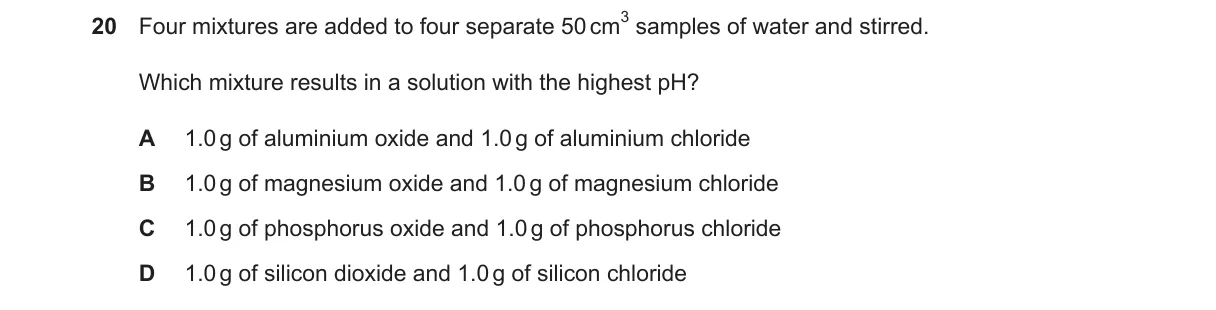
Explanation
Basic oxide with neutral chloride yields highest pH
Steps:
- Identify reactions of each oxide and chloride in water: oxides form hydroxides or acids, chlorides hydrolyze based on element.
- Assess pH impact: basic oxides raise pH, acidic ones lower it; hydrolysis acidity varies by metal/nonmetal.
- Compare mixtures: evaluate net effect of oxide basicity vs. chloride acidity for each.
- Select highest pH: mixture with strongest base and least acidic salt.
Why B is correct:
- MgO dissolves slightly to form Mg(OH)₂ (weak base, pH >7 per solubility equilibrium), while MgCl₂ is neutral (no hydrolysis per ionic salt definition).
Why the others are wrong:
- A: Al₂O₃ insoluble (amphoteric, no pH change), AlCl₃ hydrolyzes to H⁺ (Al³⁺ + H₂O → Al(OH)₃ + H⁺), acidic.
- C: P₄O₁₀ forms H₃PO₄ (acidic per anhydride reaction), PCl₅ yields H₃PO₄ + HCl (strong acid hydrolysis).
- D: SiO₂ insoluble (network solid), SiCl₄ hydrolyzes to H⁺ + silicic acid (SiCl₄ + 4H₂O → Si(OH)₄ + 4HCl).
Final answer: B
Topic: Group 2
Practice more A Levels Chemistry (9701) questions on mMCQ.me