A Levels Chemistry (9701)•9701/11/O/N/23
Explanation
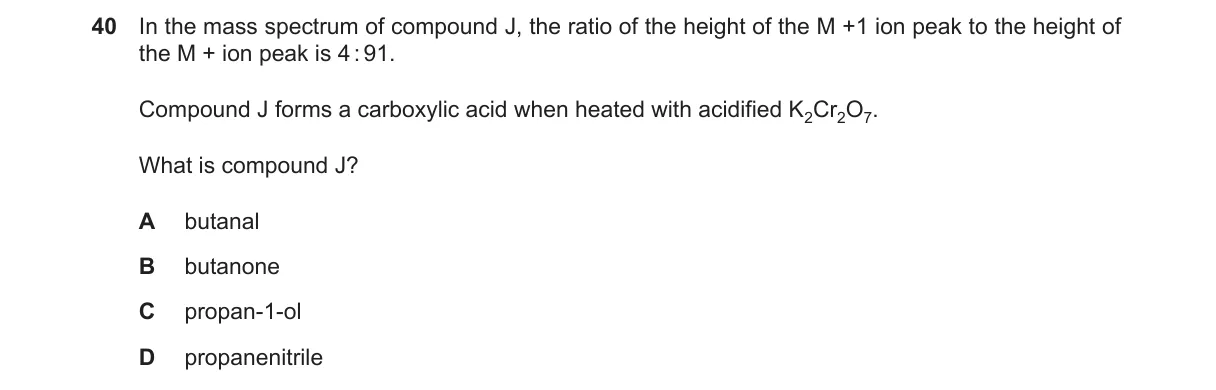
Mass spectrum M+:(M-1)+ ratio and oxidation test identify aldehyde
Steps:
- Oxidation with acidified K2Cr2O7 to carboxylic acid shows J is a primary alcohol or aldehyde.
- Mass spectrum ratio M+:(M-1)+ = 4:1 indicates significant [M-H]+ peak from easy H loss.
- Aldehydes lose aldehydic H• to form stable acylium ion RCO+ at M-1, giving ~20-25% intensity relative to M+.
- Primary alcohols have weak M+ and insignificant M-1; they fragment via M-18 (water loss).
- Nitriles require concentrated acid hydrolysis, not K2Cr2O7 oxidation.
Why A is correct:
- Butanal (CH3CH2CH2CHO) is an aldehyde that oxidizes to butanoic acid and shows prominent M-1 (71) at 25% of M+ (72) due to stable C3H7CO+ formation.
Why the others are wrong:
- B. Butanol is a primary alcohol; weak M+ and no prominent M-1 peak.
- C. Propan-1-ol is a primary alcohol; same mass spec issue as B.
- D. Propanenitrile hydrolyzes to propanoic acid only with hot conc. HCl, not acidified K2Cr2O7.
Final answer: A
Topic: Analytical techniques
Practice more A Levels Chemistry (9701) questions on mMCQ.me