A Levels Chemistry (9701)•9701/11/O/N/23
Explanation
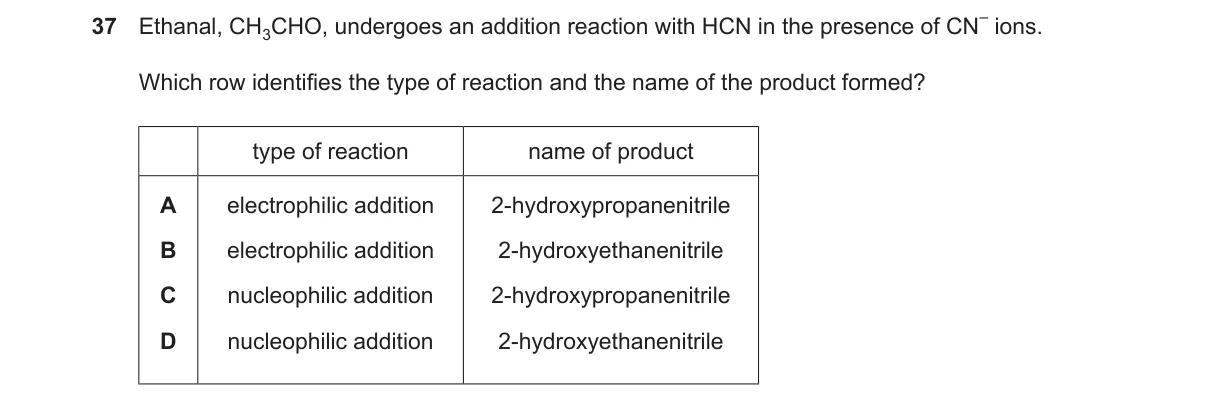
Nucleophilic Addition to Aldehydes with HCN
Steps:
- Recognize CH3CHO as acetaldehyde, an aldehyde with a polar C=O bond where carbon is electrophilic.
- In the presence of CN-, cyanide ion acts as a nucleophile attacking the carbonyl carbon.
- H+ from HCN then protonates the oxygen, forming CH3CH(OH)CN.
- Name the product: carbon chain is three carbons (CH3-CH(OH)-CN), so 2-hydroxypropanenitrile.
Why C is correct:
- Aldehydes undergo nucleophilic addition with HCN; CN- adds to C=O (electrophile), yielding 2-hydroxypropanenitrile (CH3CH(OH)CN) per IUPAC naming for the three-carbon chain.
Why the others are wrong:
- A: Incorrect reaction type; carbonyls attract nucleophiles, not undergo electrophilic addition.
- B: Incorrect reaction type and product name; it's nucleophilic, and ethanenitrile implies two carbons (wrong for CH3CH(OH)CN).
- D: Incorrect product name; ethanenitrile (two carbons) mismatches the three-carbon structure from acetaldehyde.
Final answer: C
Topic: Carbonyl compounds
Practice more A Levels Chemistry (9701) questions on mMCQ.me