A Levels Chemistry (9701)•9701/11/O/N/23
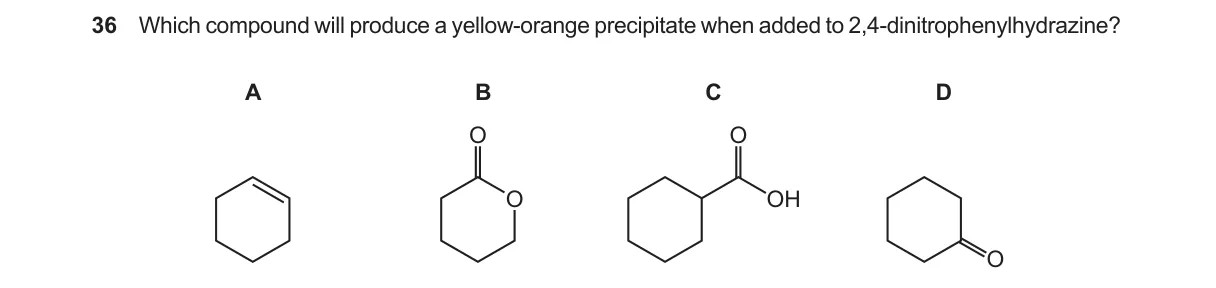
Explanation
2,4-DNPH Test for Aldehydes and Ketones Steps:
- Recall that 2,4-dinitrophenylhydrazine (DNPH) reacts with carbonyl groups (C=O) in aldehydes and ketones to form yellow-orange hydrazone precipitates.
- Examine each choice for the presence of an aldehyde (-CHO) or ketone (>C=O) functional group.
- Eliminate options lacking a reactive carbonyl, such as alcohols, carboxylic acids, or esters.
- Identify the option with an aldehyde or ketone as the positive result.
Why D is correct:
- Compound D contains a ketone group, which reacts with DNPH to form the characteristic yellow-orange 2,4-dinitrophenylhydrazone precipitate, as per the standard carbonyl identification test.
Why the others are wrong:
- A lacks a carbonyl; it's an alcohol that does not react with DNPH.
- B is a carboxylic acid; the -COOH group does not form a precipitate with DNPH.
- C is an ester; esters are unreactive toward DNPH under test conditions.
Final answer: D
Topic: Carbonyl compounds
Practice more A Levels Chemistry (9701) questions on mMCQ.me