A Levels Chemistry (9701)•9701/11/O/N/23
Explanation
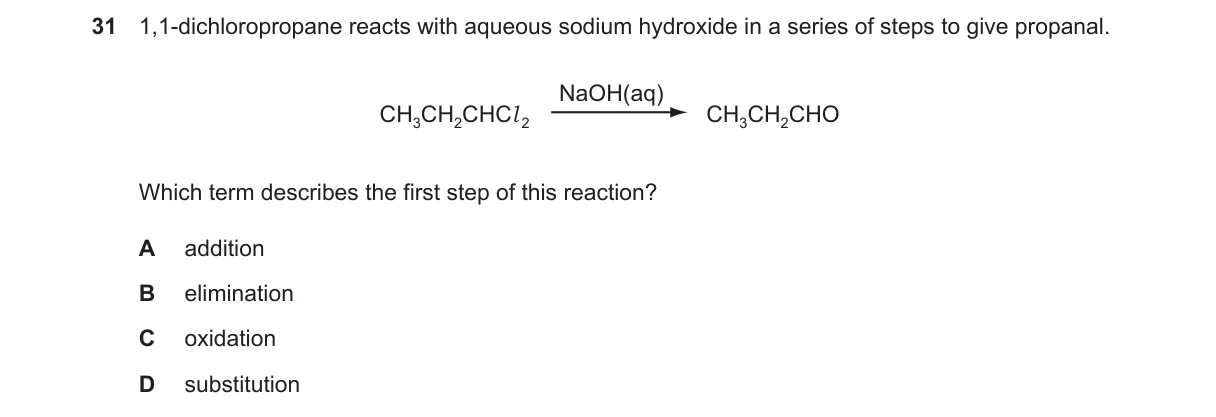
First step is nucleophilic substitution of a geminal dihalide
Steps:
- Identify reactant: 1,1-dichloropropane (CH3CH2CHCl2) has two Cl atoms on the same carbon.
- Aqueous NaOH provides OH- nucleophile, which attacks the carbon bearing Cl.
- One Cl is replaced by OH, forming CH3CH2CH(OH)Cl (1-chloro-1-propanol).
- This substitution sets up hydrolysis to propanal in later steps.
Why D is correct:
- Substitution replaces one halogen with OH via SN1 or SN2 mechanism, where OH- displaces Cl- per the general reaction R-X + OH- → R-OH + X-.
Why the others are wrong:
- A. Addition involves electrophilic attack on unsaturated bonds like alkenes, not present in the saturated dihalide.
- B. Elimination removes HX to form double bonds (e.g., E2 mechanism), yielding alkenes, not aldehydes.
- C. Oxidation requires loss of electrons or addition of oxygen without halogen replacement, unlike the initial Cl-to-OH swap.
Final answer: D
Topic: Halogen compounds
Practice more A Levels Chemistry (9701) questions on mMCQ.me