A Levels Chemistry (9701)•9701/11/O/N/23
Explanation
Chlorine Disproportionation in Aqueous Solution
Steps:
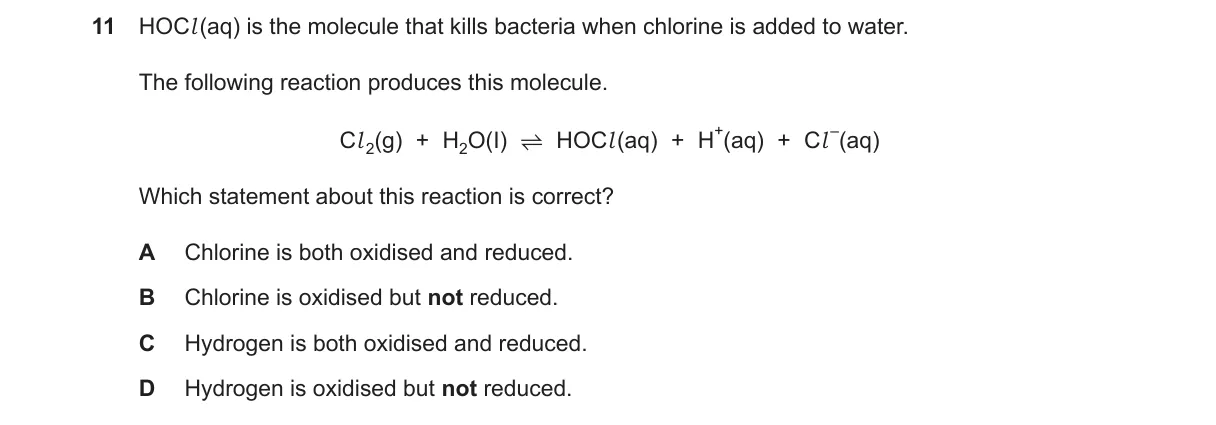
- Assign oxidation states: In Cl₂, Cl is 0; in H₂O, H is +1 and O is -2.
- In products, Cl in HOCl is +1 (H +1, O -2, so Cl +1); Cl in Cl⁻ is -1; H in H⁺ is +1.
- One Cl atom oxidizes from 0 to +1 in HOCl, losing electrons.
- Another Cl atom reduces from 0 to -1 in Cl⁻, gaining electrons.
Why A is correct:
- This is a disproportionation reaction, where chlorine is simultaneously oxidized and reduced, per the definition of redox processes involving the same element.
Why the others are wrong:
- B: Chlorine is also reduced to Cl⁻, not just oxidized.
- C: Hydrogen's oxidation state remains +1 in both H₂O and H⁺, so it is neither oxidized nor reduced.
- D: Identical to C; hydrogen shows no redox change.
Final answer: A
Topic: Electrochemistry
Practice more A Levels Chemistry (9701) questions on mMCQ.me