A Levels Chemistry (9701)•9701/13/O/N/22
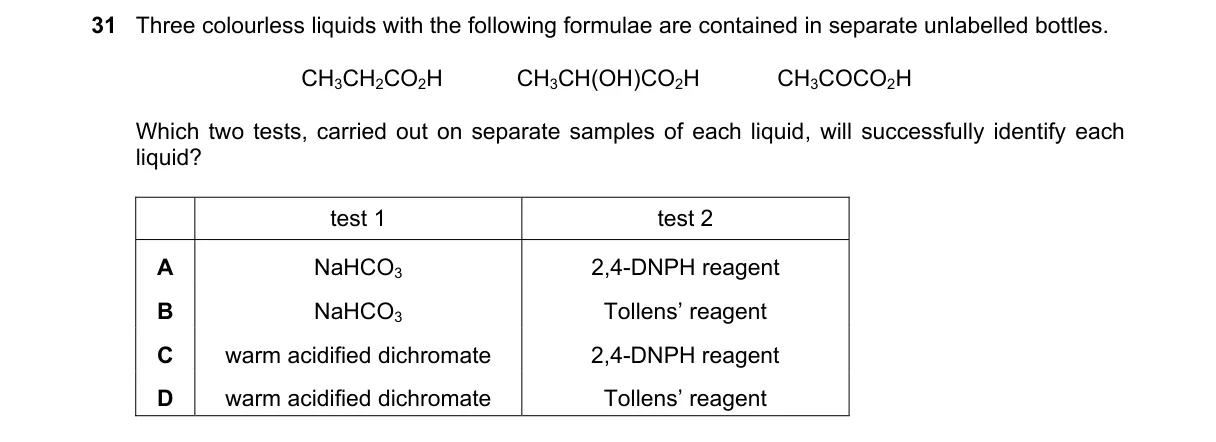
Explanation
Distinguishing acid, alcohol, and ester via oxidation and carbonyl reactivity Steps:
- Apply warm acidified dichromate to one sample: ethanol oxidizes (orange to green color change), while CH3COOH and CH3COOCH3 do not.
- Apply 2,4-DNP to another sample: CH3COOCH3 forms orange precipitate (ester carbonyl), while CH3COOH and CH3CH2OH do not.
- Ethanol shows oxidation yes, 2,4-DNP no.
- CH3COOH shows both no; CH3COOCH3 shows oxidation no, 2,4-DNP yes—unique patterns identify each.
Why C is correct:
- Warm acidified dichromate tests oxidizability (per Jones oxidation, primary alcohols react); 2,4-DNP tests free carbonyls (hydrazone formation), yielding distinct results per functional group.
Why the others are wrong:
- A: NaHCO3 effervesces only with acid (CO2 from H+ + HCO3-); 2,4-DNP negative for all, confuses alcohol and ester.
- B: Warm NaHCO3 still reacts only with acid; 2,4-DNP negative for all, same confusion.
- D: Dichromate identifies alcohol; Tollens (Ag mirror for aldehydes) negative for all, confuses acid and ester.
Final answer: C
Topic: Carboxylic acids and derivatives
Practice more A Levels Chemistry (9701) questions on mMCQ.me