A Levels Chemistry (9701)•9701/12/O/N/22
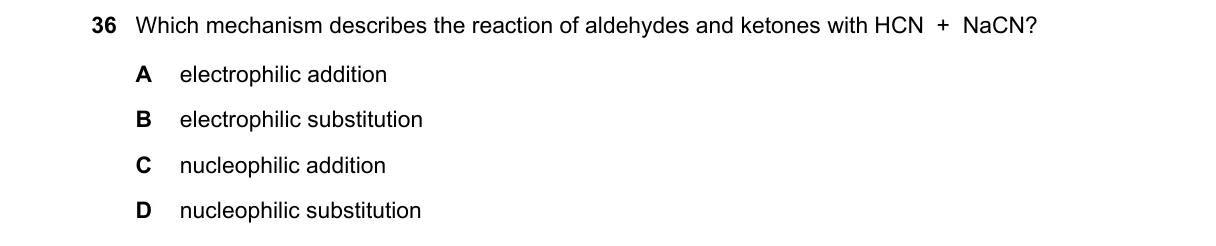
Explanation
Nucleophilic Addition to Carbonyl Groups
Steps:
- Aldehydes and ketones contain a polar C=O bond, making the carbon electrophilic.
- HCN + NaCN generates CN⁻, a strong nucleophile.
- CN⁻ attacks the electrophilic carbonyl carbon, forming a tetrahedral intermediate.
- Protonation yields the cyanohydrin product via addition.
Why C is correct:
- Nucleophilic addition occurs when a nucleophile like CN⁻ bonds to the electrophilic carbonyl carbon, following the mechanism for carbonyl reactions (e.g., R₂C=O + CN⁻ → R₂C(OH)CN).
Why the others are wrong:
- A: Electrophilic addition involves an electrophile attacking a nucleophilic site like alkenes, not the electrophilic carbonyl carbon.
- B: Electrophilic substitution replaces a hydrogen or group on an aromatic ring, irrelevant to carbonyl addition.
- D: Nucleophilic substitution requires a leaving group to depart, but no such group exists in carbonyls for this reaction.
Final answer: C
Topic: Carbonyl compounds
Practice more A Levels Chemistry (9701) questions on mMCQ.me