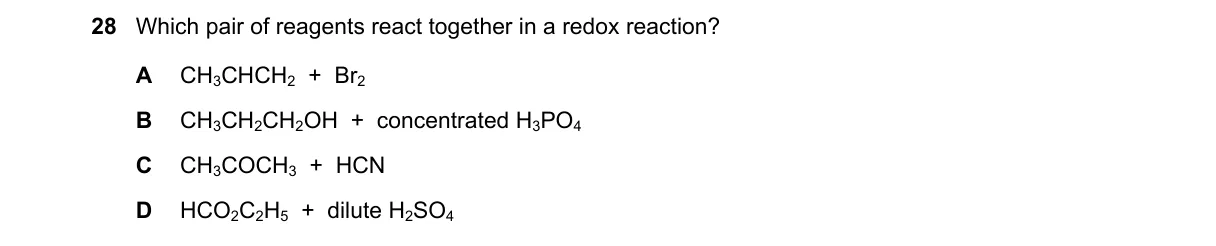
Explanation
Redox reactions involve electron transfer and oxidation state changes Steps: - Recall that redox reactions require one species to be oxidized (lose electrons) and another reduced (gain electrons), changing oxidation states. - Analyze each pair: check if the reagents can exchange electrons, using standard oxidation state rules for organic compounds (C-H bond: -1 for C; C-Br: +1 for C; C-C: 0; halogens like Br₂ at 0). - For A, assume Br as Br₂ (common notation); bromoethane's CH₃ group can undergo radical substitution with Br₂ under light, oxidizing C from -3 to -1 while reducing Br from 0 to -1. - Confirm others lack such transfer, confirming A as the redox pair. Why A is correct: - In radical bromination, CH₃CH₂Br + Br₂ forms CH₂BrCH₂Br; C oxidation state shifts from -3 (in CH₃) to -2 (in CH₂Br) per bond rules, while Br₂ reduces (0 to -1), fitting redox definition. Why the others are wrong: - B: Ethanol + conc. H₃PO₄ undergoes acid-catalyzed dehydration to ethene; elimination, no electron transfer or oxidation state change for P or C. - C: Acetone + …
Practice more A Levels Chemistry (9701) questions on mMCQ.me