A Levels Chemistry (9701)•9701/11/O/N/22
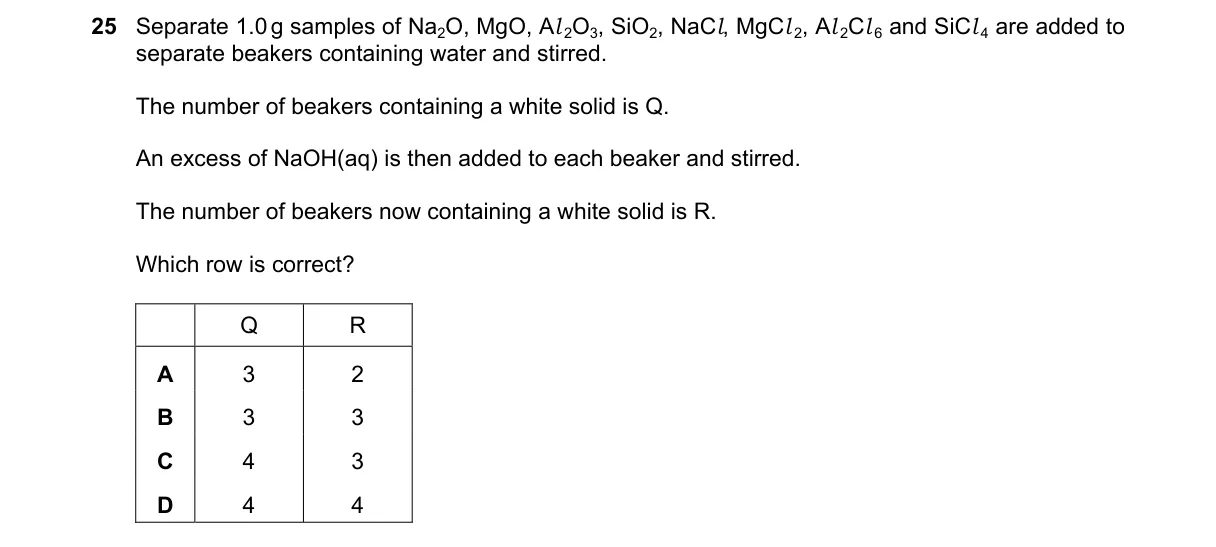
Explanation
Solubility of oxides/chlorides in water and reaction with excess NaOH Steps:
- In water: Na₂O reacts to soluble NaOH (no solid); MgO reacts to insoluble Mg(OH)₂ (white solid); Al₂O₃ insoluble (white solid); SiO₂ insoluble (white solid); NaCl soluble (no solid); MgCl₂ soluble (no solid); AlCl₃ soluble, partial hydrolysis but clear solution (no solid); SiCl₄ hydrolyzes to insoluble Si(OH)₄ (white solid). Thus, 4 beakers have white solids (MgO, Al₂O₃, SiO₂, SiCl₄): Q=4.
- Add excess NaOH: MgO's Mg(OH)₂ remains insoluble; Al₂O₃ dissolves to NaAlO₂; SiO₂ dissolves to Na₂SiO₃; SiCl₄'s Si(OH)₄ remains insoluble; Na₂O/NaCl stay clear; MgCl₂ forms insoluble Mg(OH)₂; AlCl₃ forms insoluble Al(OH)₃. Thus, 4 beakers have white solids (MgO, SiCl₄, MgCl₂, AlCl₃): R=4. Why D is correct:
- Q=4 initial insoluble/insoluble products; R=4 after NaOH, as non-amphoteric remain/form while Al₂O₃/SiO₂ dissolve but Al(OH)₃/Si(OH)₄ do not (standard qualitative distinction). Why the others are wrong:
- A: Underestimates Q (ignores SiCl₄ solid) and R (misses two hydroxides).
- B: Underestimates Q (ignores SiCl₄) and R=3 (wrong count post-NaOH).
- C: Correct Q=4 but underestimates R (misses AlCl₃ or SiCl₄ post-NaOH).
Topic: The Periodic Table: chemical periodicity
Practice more A Levels Chemistry (9701) questions on mMCQ.me