A Levels Chemistry (9701)•9701/11/O/N/22
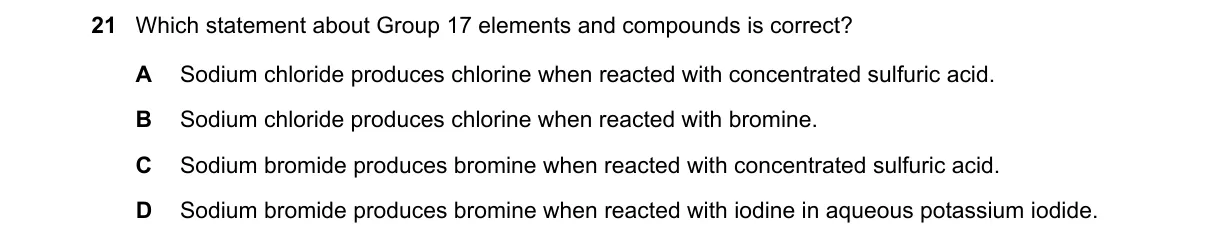
Explanation
Oxidation of halides by concentrated sulfuric acid
Steps:
- Halogens follow reactivity order F > Cl > Br > I; stronger halogens displace weaker ones from compounds.
- Concentrated H₂SO₄ reacts with NaCl to form HCl gas without oxidation to Cl₂.
- With NaBr, H₂SO₄ first forms HBr, then oxidizes it to Br₂ due to Br⁻'s susceptibility.
- I₂ cannot displace Br⁻ from NaBr as I is less reactive than Br.
Why C is correct:
- Concentrated H₂SO₄ oxidizes Br⁻ to Br₂ via 2HBr + H₂SO₄ → Br₂ + SO₂ + 2H₂O, producing bromine from sodium bromide.
Why the others are wrong:
- A: Br₂ cannot displace Cl⁻ from NaCl as Cl is more reactive than Br.
- B: NaCl + conc. H₂SO₄ → NaHSO₄ + HCl; no Cl₂ produced as Cl⁻ resists oxidation.
- D: I₂ in aqueous KI cannot displace Br⁻ from NaBr as I is less reactive than Br.
Final answer: C
Topic: Group 17
Practice more A Levels Chemistry (9701) questions on mMCQ.me