A Levels Chemistry (9701)•9701/12/O/N/21
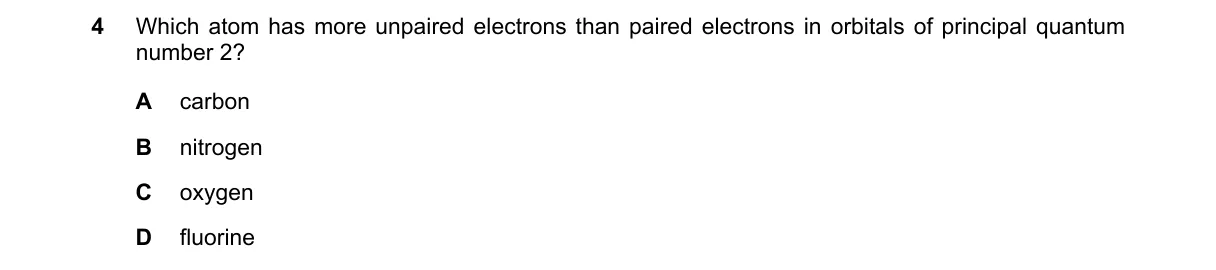
Explanation
Unpaired vs. paired electrons in n=2 shell via Hund's rule
Steps:
- Determine ground-state configurations: C (1s²2s²2p²), N (1s²2s²2p³), O (1s²2s²2p⁴), F (1s²2s²2p⁵).
- For n=2 (2s² paired for all; 2p varies), apply Hund's rule: singly occupy orbitals before pairing.
- Count in n=2: C (2 unpaired, 2 paired), N (3 unpaired, 2 paired), O (2 unpaired, 4 paired), F (1 unpaired, 6 paired).
- Select atom where unpaired > paired: only nitrogen.
Why B is correct:
- Nitrogen's 2p³ has three unpaired electrons (one per orbital) and 2s² has two paired, totaling more unpaired than paired in n=2.
Why the others are wrong:
- A. Carbon's 2p² has two unpaired and 2s² two paired; numbers equal.
- C. Oxygen's 2p⁴ has two unpaired (two singles) and two paired (one pair), plus 2s² (two paired); more paired.
- D. Fluorine's 2p⁵ has one unpaired (one single) and four paired (two pairs), plus 2s² (two paired); more paired.
Final answer: B
Topic: Atomic structure
Practice more A Levels Chemistry (9701) questions on mMCQ.me