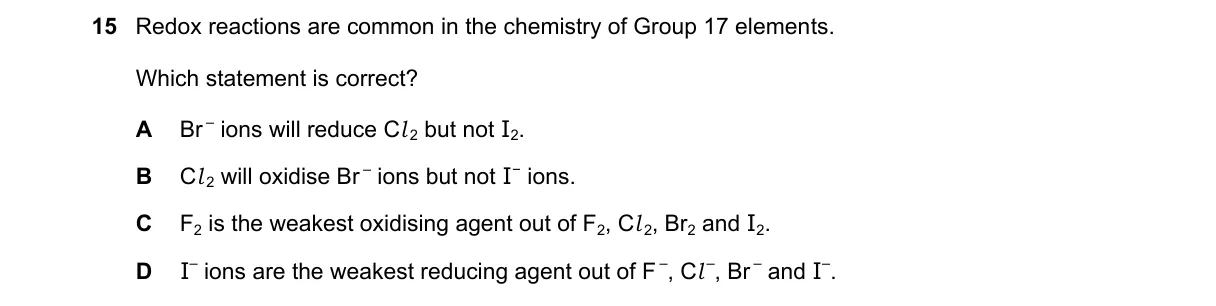
Explanation
Halogen redox reactivity follows standard reduction potentials Steps: - Standard reduction potentials decrease down Group 17: E°(Cl₂/Cl⁻) = +1.36 V > E°(Br₂/Br⁻) = +1.07 V > E°(I₂/I⁻) = +0.54 V. - Stronger oxidizing agents (higher E°) displace halides of weaker halogens in spontaneous reactions. - For Br⁻ and Cl₂: ΔE° = 1.36 - 1.07 = +0.29 V > 0, so Cl₂ + 2Br⁻ → Br₂ + 2Cl⁻ occurs (Br⁻ reduces Cl₂ to Cl⁻). - For Br⁻ and I₂: ΔE° = 0.54 - 1.07 = -0.53 V < 0, so no reaction (Br⁻ does not reduce I₂ to I⁻). Why A is correct: - Br⁻ reduces Cl₂ (forming Cl⁻) due to Cl₂'s higher E° than Br₂, but cannot reduce I₂ (forming I⁻) as I₂'s E° is lower than Br₂'s, per the spontaneity rule for redox reactions. Why the others are wrong: - B: F₂ has the highest E° (+2.87 V), making it the strongest oxidizing agent, not weakest. - C: Cl₂ oxidizes both Br⁻ and I⁻, as its E° exceeds both Br₂/Br⁻ and I₂/I⁻ couples. - D: I⁻ is the strongest …
Practice more A Levels Chemistry (9701) questions on mMCQ.me