A Levels Chemistry (9701)•9701/12/O/N/21
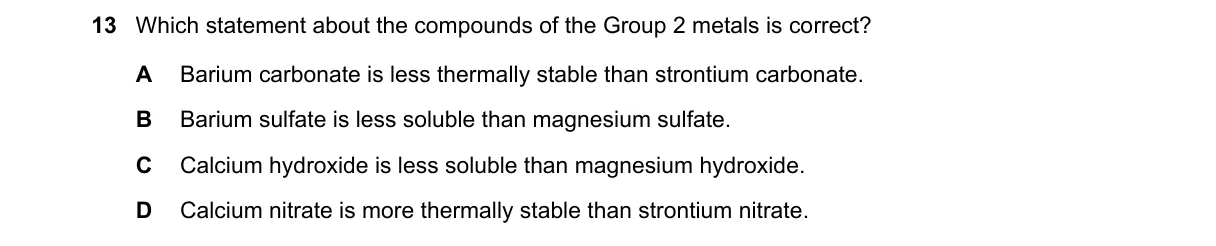
Explanation
Group 2 compound trends: solubility decreases for sulfates, stability increases down group for carbonates and hydroxides Steps:
- Identify solubility trend for Group 2 sulfates: decreases from Mg to Ba due to increasing lattice energy dominance over hydration energy.
- Check thermal stability of carbonates: increases down group as larger cations polarize CO3^2- less, stabilizing it.
- Assess hydroxide solubility: increases down group from Mg(OH)2 (least soluble) to Ba(OH)2.
- Evaluate nitrate thermal stability: decomposition temperature rises down group, indicating higher stability for heavier metals. Why A is correct:
- Barium sulfate's low solubility (Ksp ~10^-10) compared to magnesium sulfate (fully soluble) follows the group's decreasing solubility trend, explained by Fajans' rules and lattice energy. Why the others are wrong:
- B: Barium carbonate is more thermally stable than strontium carbonate, decomposing at higher temperatures (~1360°C vs. ~1290°C).
- C: Calcium hydroxide is more soluble (Ksp ~5×10^-6) than magnesium hydroxide (Ksp ~10^-11).
- D: Calcium nitrate decomposes at lower temperature (~500°C) than strontium nitrate (~600°C), so less stable. Final answer: A
Topic: Group 2
Practice more A Levels Chemistry (9701) questions on mMCQ.me