A Levels Chemistry (9701)•9701/11/O/N/21
Explanation
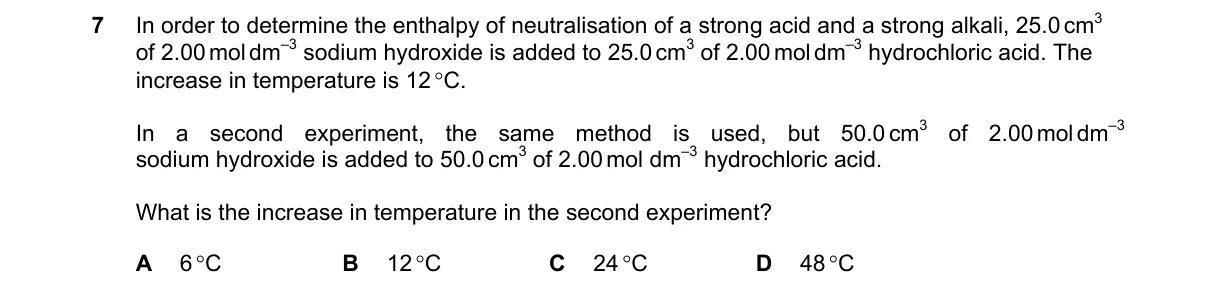
Temperature rise is independent of scale for equal concentrations
Steps:
- Calculate moles in first experiment: 25 cm³ = 0.025 dm³, so 0.025 × 2 = 0.05 mol NaOH and 0.05 mol HCl; they fully react, releasing heat for 0.05 mol neutralization.
- Total volume = 50 cm³; heat capacity proportional to volume; ΔT = 12°C.
- In second experiment: 50 cm³ = 0.05 dm³, so 0.05 × 2 = 0.1 mol each; heat doubles for 0.1 mol neutralization.
- Total volume = 100 cm³ (doubles); since heat and heat capacity both double, ΔT remains 12°C.
Why B is correct:
- Enthalpy of neutralization for strong acid-base is constant (-57 kJ/mol H₂O); q = n × ΔH, and ΔT = q / (m c), so scaling moles and mass equally keeps ΔT constant.
Why the others are wrong:
- A: Ignores doubled moles, assuming same heat but doubled mass (halves ΔT).
- C: Assumes doubled heat without doubled mass (doubles ΔT).
- D: Assumes quadrupled heat relative to mass (quadruples ΔT).
Final answer: B
Topic: Chemical energetics
Practice more A Levels Chemistry (9701) questions on mMCQ.me