A Levels Chemistry (9701)•9701/13/O/N/20
Explanation
Precipitate Formation in Reactions
Steps:
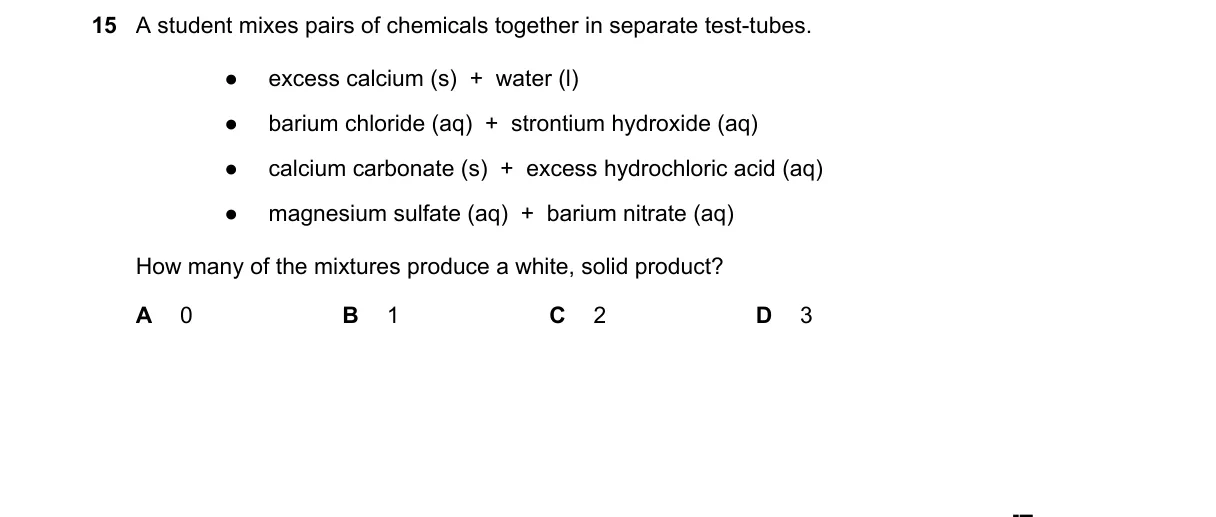
- Excess Ca(s) + H₂O(l) → Ca(OH)₂(s) (white precipitate) + H₂(g); produces white solid.
- BaCl₂(aq) + Sr(OH)₂(aq) → Ba(OH)₂(aq) + SrCl₂(aq); all products soluble, no solid.
- CaCO₃(s) + excess HCl(aq) → CaCl₂(aq) + H₂O(l) + CO₂(g); solid dissolves, no precipitate remains.
- MgSO₄(aq) + Ba(NO₃)₂(aq) → Mg(NO₃)₂(aq) + BaSO₄(s) (white precipitate); produces white solid.
Why C is correct:
- Two mixtures (1 and 4) form insoluble white solids per solubility rules: Ca(OH)₂ sparingly soluble, BaSO₄ insoluble.
Why the others are wrong:
- A: Ignores two white precipitates formed.
- B: Understates; exactly two solids produced.
- D: Overstates; only two, not three, yield white solids.
Final answer: C
Topic: Group 2
Practice more A Levels Chemistry (9701) questions on mMCQ.me