A Levels Chemistry (9701)•9701/12/O/N/20
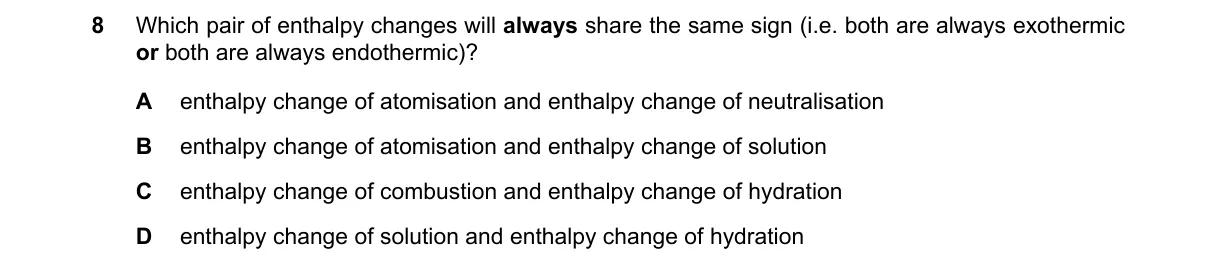
Explanation
Enthalpy changes with consistently exothermic signs Steps:
- Define each enthalpy change and its typical sign based on bond breaking/forming.
- Atomisation: always endothermic (breaks metal lattice or bonds to form gaseous atoms).
- Neutralisation: always exothermic (acid-base reaction forms bonds in water).
- Combustion: always exothermic (fuels oxidize, forming strong C=O and O-H bonds).
- Hydration: always exothermic (gaseous ions form attractions with water dipoles).
- Solution: variable sign (for ionic solids, lattice breaking endothermic, hydration exothermic; net depends on magnitudes). Why B is correct:
- Both combustion and hydration always release energy (ΔH < 0), as combustion involves exothermic oxidation and hydration exothermic solvation per Hess's law applications. Why the others are wrong:
- A: Atomisation endothermic, neutralisation exothermic—opposite signs.
- C: Solution can be endothermic or exothermic, hydration always exothermic—not always same.
- D: Identical to C, so solution varies while hydration exothermic—not always same.
Final answer: B
Topic: Chemical energetics
Practice more A Levels Chemistry (9701) questions on mMCQ.me