A Levels Chemistry (9701)•9701/12/O/N/20
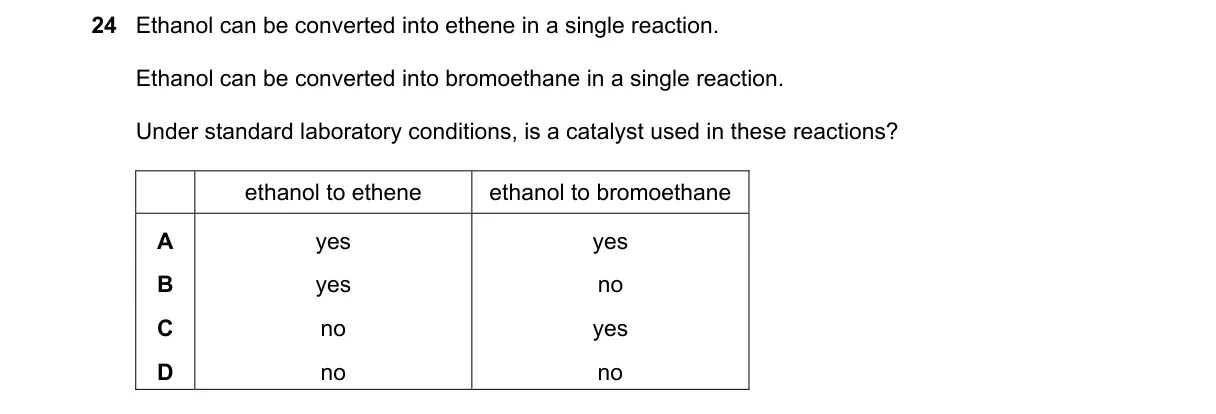
Explanation
Catalysts in ethanol reactions
Steps:
- Identify ethanol to ethene as acid-catalyzed dehydration: CH3CH2OH → CH2=CH2 + H2O, using concentrated H2SO4 at 170°C.
- Confirm standard lab conditions require H2SO4 as catalyst for dehydration to remove water efficiently.
- Identify ethanol to bromoethane as nucleophilic substitution: CH3CH2OH + HBr → CH3CH2Br + H2O, proceeding without catalyst.
- Verify halogenation uses reagent like HBr directly, no additional catalyst needed under lab conditions.
Why B is correct:
- Dehydration follows the mechanism where H2SO4 acts as a catalyst by protonating the alcohol, facilitating water loss per organic chemistry principles.
Why the others are wrong:
- A: Bromoethane formation uses HBr as reactant, not catalyst.
- C: Ethene requires acid catalyst for dehydration.
- D: Ethene dehydration mandates catalyst use.
Final answer: B
Topic: Hydroxy compounds
Practice more A Levels Chemistry (9701) questions on mMCQ.me