A Levels Chemistry (9701)•9701/11/O/N/20
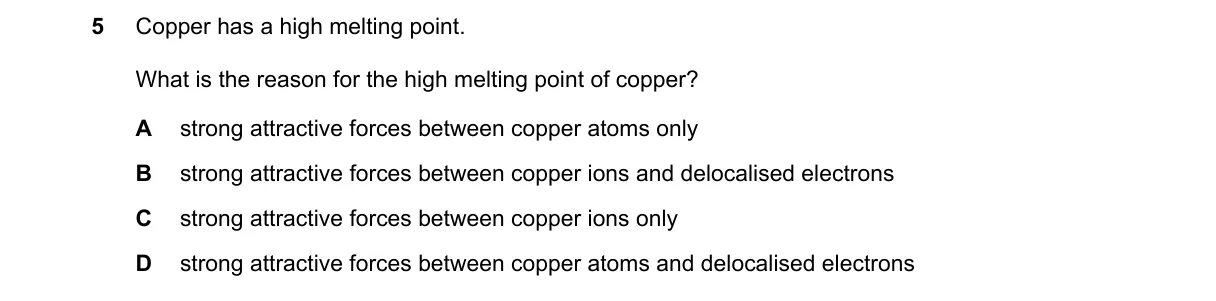
Explanation
Metallic Bonding in Copper
Steps:
- Copper is a transition metal that forms a giant metallic lattice.
- In this lattice, copper atoms donate valence electrons to create positive ions and a sea of delocalized electrons.
- The strong electrostatic attraction between these ions and delocalized electrons holds the structure together.
- Overcoming this attraction requires significant energy, resulting in a high melting point.
Why B is correct:
- Metallic bonding is defined by the electrostatic forces between positively charged metal ions and freely moving delocalized electrons, which provide strength and explain copper's high melting point (around 1085°C).
Why the others are wrong:
- A: Copper does not form covalent bonds between neutral atoms; metallic bonding involves ions, not atoms alone.
- C: Attractions occur between ions, not neutral atoms, which would imply incorrect covalent character.
- D: Lacks "only," failing to emphasize that ion-electron forces are the sole key attractive interaction in pure metallic copper.
Final answer: B
Topic: Chemistry of transition elements
Practice more A Levels Chemistry (9701) questions on mMCQ.me