A Levels Chemistry (9701)•9701/11/O/N/20
Explanation
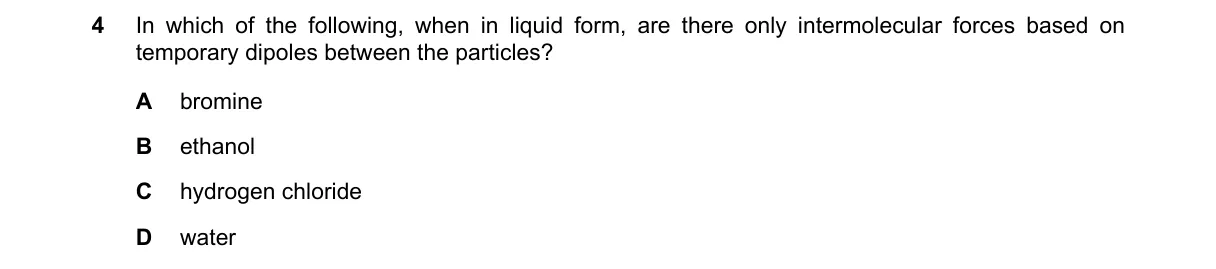
Intermolecular Forces: London Dispersion Only in Nonpolar Liquids
Steps:
- Temporary dipoles refer to London dispersion forces, which are the sole intermolecular forces in nonpolar substances.
- Determine molecular polarity: nonpolar molecules lack permanent dipoles, so only temporary dipole-induced forces occur.
- Analyze each option: bromine (Br₂) is nonpolar; hydrogen chloride (HCl) is polar; ethanol (C₂H₅OH) and water (H₂O) form hydrogen bonds.
- Select the nonpolar liquid with exclusively dispersion forces.
Why A is correct:
- Bromine (Br₂) is a symmetrical nonpolar diatomic molecule, so intermolecular forces are solely London dispersion forces from temporary dipoles, as defined by van der Waals interactions in nonpolar liquids.
Why the others are wrong:
- B: HCl has a permanent dipole due to electronegativity difference, leading to dipole-dipole forces beyond temporary dipoles.
- C: Ethanol contains O-H bonds, enabling hydrogen bonding, a stronger force than temporary dipoles.
- D: Water's O-H bonds allow hydrogen bonding between molecules, not limited to temporary dipoles.
Final answer: A
Topic: States of matter
Practice more A Levels Chemistry (9701) questions on mMCQ.me