A Levels Chemistry (9701)•9701/12/O/N/19
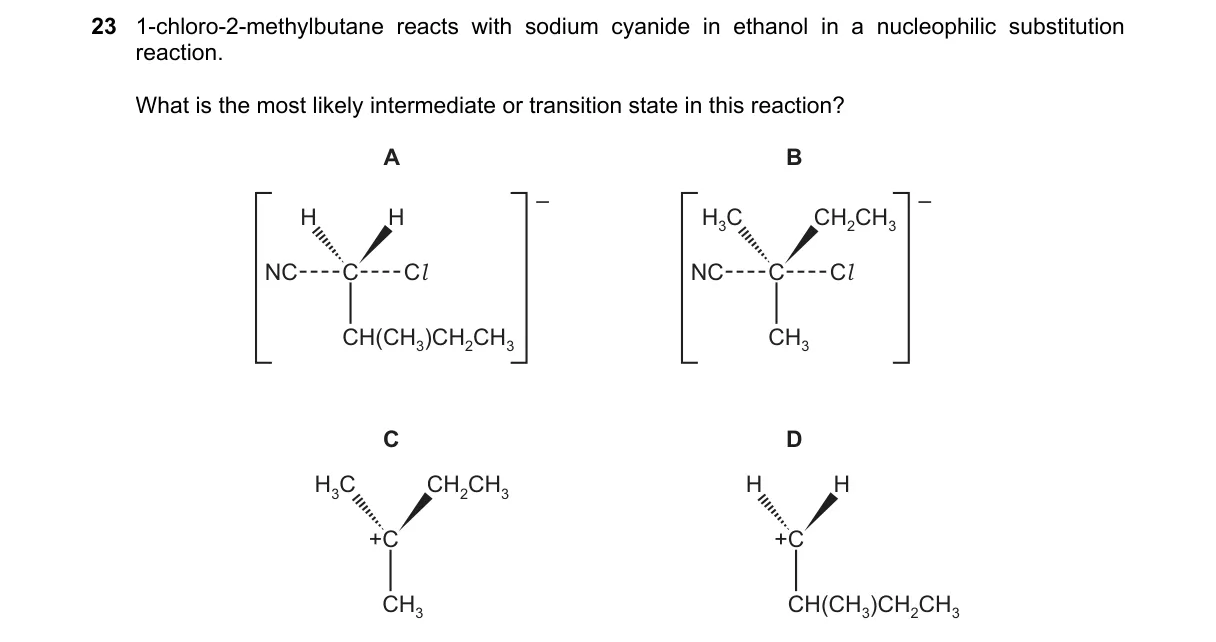
Explanation
SN2 mechanism for primary alkyl halide
Steps:
- Classify substrate: 1-chloro-2-methylbutane is a primary alkyl chloride.
- Assess nucleophile and solvent: CN⁻ is a strong nucleophile; ethanol is polar protic but favors SN2 for primaries.
- Rule out SN1: Primary halides resist carbocation formation due to instability.
- Conclude mechanism: Concerted SN2 with backside attack transition state.
Why A is correct:
- A shows the SN2 transition state with pentacoordinate carbon, partial bonds to CN⁻ and Cl⁻, per SN2 definition of concerted substitution.
Why the others are wrong:
- B depicts a carbocation intermediate, characteristic of SN1, unlikely for primary substrate.
- C illustrates frontside attack, violating SN2 inversion stereochemistry.
- D represents a free radical species, irrelevant to nucleophilic substitution.
Final answer: A
Topic: Halogen compounds
Practice more A Levels Chemistry (9701) questions on mMCQ.me