A Levels Chemistry (9701)•9701/11/O/N/19
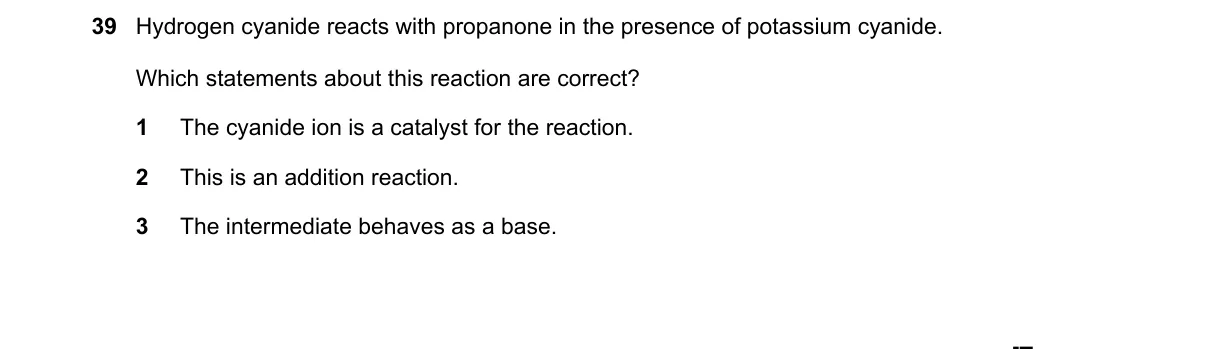
Explanation
Cyanohydrin formation mechanism
Steps:
- Propanone's carbonyl carbon is electrophilic and attacked by nucleophilic CN⁻ from KCN.
- CN⁻ addition forms tetrahedral alkoxide intermediate, [ (CH₃)₂C(O⁻)CN ].
- Intermediate deprotonates HCN, yielding cyanohydrin product and regenerating CN⁻.
- Overall, HCN adds across C=O bond.
Why A is correct:
- A catalyst speeds reaction without net consumption; CN⁻ adds to carbonyl then regenerates by abstracting H⁺ from HCN.
Why the others are wrong:
- B: Reaction is nucleophilic addition, but statement omits specificity, making it incomplete.
- C: Intermediate is nucleophilic anion that accepts proton, but it primarily acts as nucleophile in addition step.
- D: Not enough information (option incomplete).
Final answer: A
Topic: Carbonyl compounds
Practice more A Levels Chemistry (9701) questions on mMCQ.me