A Levels Chemistry (9701)•9701/11/O/N/19
Explanation
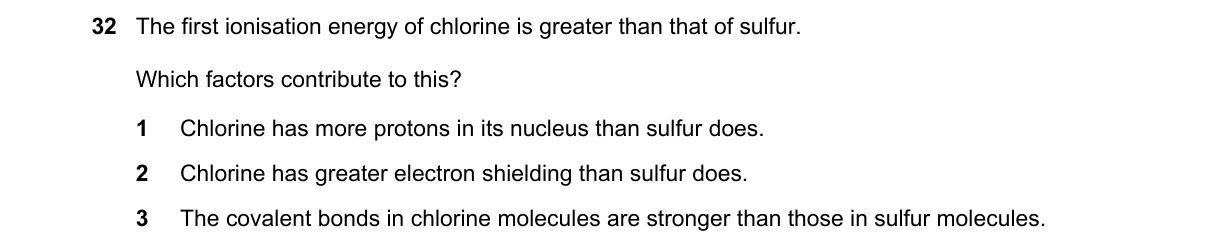
Effective nuclear charge drives higher ionization energy for chlorine
Steps:
- Identify positions: Chlorine (group 17) and sulfur (group 16) are in period 3, so they have the same number of electron shells.
- Recall trend: Ionization energy increases across a period due to rising nuclear charge with constant shielding.
- Compare atomic numbers: Chlorine (Z=17) has one more proton than sulfur (Z=16), increasing attraction on valence electrons.
- Conclude factor: Higher effective nuclear charge (Zeff) in chlorine requires more energy to remove an electron.
Why D is correct:
- D states valence electrons in chlorine experience greater effective nuclear charge (Zeff = Z - shielding), per Slater's rules, as both have identical core electrons but chlorine's extra proton boosts pull without added shielding.
Why the others are wrong:
- A: More protons alone ignores similar shielding; it's the net Zeff that matters.
- B: Shielding is nearly identical (same inner shells); valence electrons don't shield each other effectively.
- C: Bond strengths in molecules (Cl2 vs. S8) are irrelevant; ionization energy measures isolated gaseous atoms.
Final answer: D
Topic: The Periodic Table: chemical periodicity
Practice more A Levels Chemistry (9701) questions on mMCQ.me