A Levels Chemistry (9701)•9701/11/O/N/19
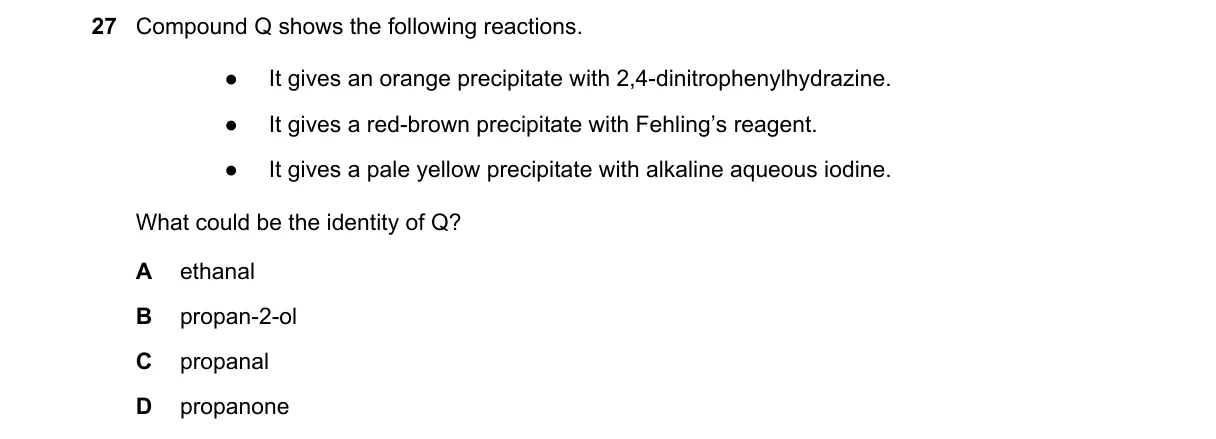
Explanation
Chemical tests identify Q as an aldehyde
Steps:
- Red precipitate with 2,4-dinitrophenylhydrazine confirms a carbonyl group (C=O) in Q, so Q is propanal or propanone.
- Orange precipitate with Fehling's reagent shows Q reduces Cu²⁺ to Cu₂O, a property of aldehydes but not ketones, identifying Q as propanal.
- Yellow precipitate with alkaline aqueous iodine (iodoform test) is consistent with structures having CH₃C=O or CH₃CH(OH), but the prior tests pinpoint propanal as the match.
- Thus, Q is the aldehyde propanal (CH₃CH₂CHO).
Why C is correct:
- Propanal (CH₃CH₂CHO) is an aldehyde that forms a hydrazone (red ppt) with 2,4-DNP per the carbonyl test and reduces Fehling's via aldehyde oxidation to carboxylic acid.
Why the others are wrong:
- A: Ethanol (CH₃CH₂OH) lacks a carbonyl, so no reaction with 2,4-DNP.
- B: Propan-1-ol (CH₃CH₂CH₂OH) lacks a carbonyl, so no reaction with 2,4-DNP.
- D: Propanone (CH₃COCH₃) is a ketone that does not reduce Fehling's reagent.
Final answer: C
Topic: Carbonyl compounds
Practice more A Levels Chemistry (9701) questions on mMCQ.me