A Levels Chemistry (9701)•9701/11/O/N/19
Explanation
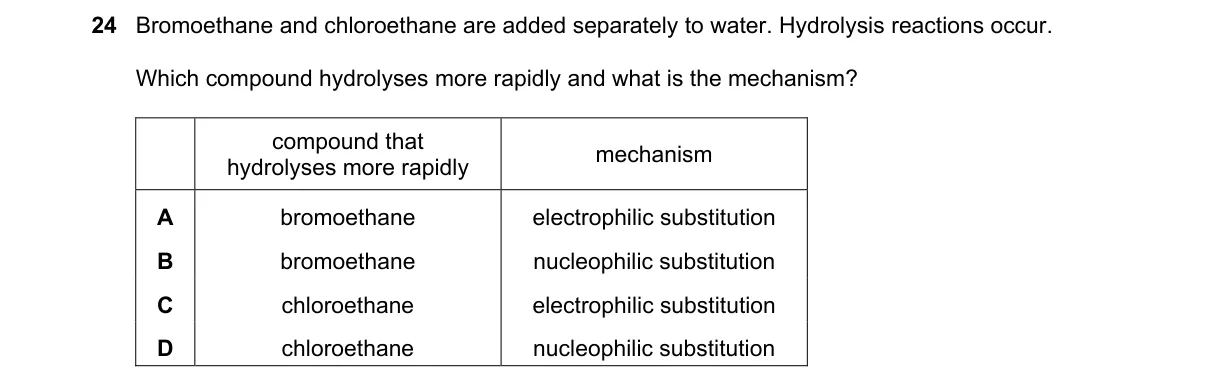
Bromoethane hydrolyzes faster in water via nucleophilic substitution
Steps:
- Identify reaction: Both undergo hydrolysis with H2O as nucleophile, replacing halogen with OH.
- Determine mechanism: Primary alkyl halides favor SN2 nucleophilic substitution.
- Compare leaving groups: Br⁻ is weaker base than Cl⁻, making it better leaving group.
- Conclude rate: SN2 rate depends on leaving group; bromoethane reacts faster.
Why A is correct:
- Bromoethane has superior Br⁻ leaving group (per leaving group ability trend: I > Br > Cl > F), accelerating SN2 hydrolysis.
Why the others are wrong:
- B: Chloroethane's Cl⁻ is poorer leaving group, so slower hydrolysis.
- C: Mechanism is nucleophilic, not electrophilic substitution (which targets electron-rich centers like aromatics).
- D: Identical to B; chloroethane hydrolyzes slower.
Final answer: A
Topic: Halogen compounds
Practice more A Levels Chemistry (9701) questions on mMCQ.me