A Levels Chemistry (9701)•9701/11/O/N/19
Explanation
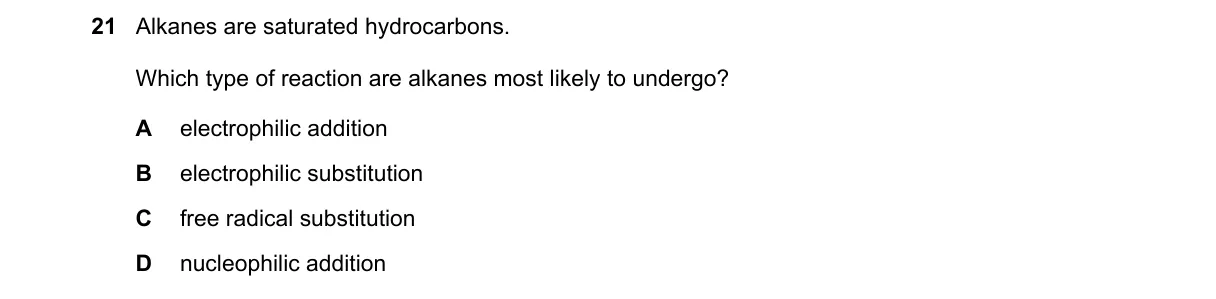
Alkanes undergo free radical reactions due to strong C-C and C-H bonds
Steps:
- Recall alkanes are saturated hydrocarbons with only single bonds, making them unreactive to most addition or ionic mechanisms.
- Identify that alkanes react with halogens under UV light, involving homolytic bond cleavage.
- Recognize this as a substitution where a hydrogen is replaced by a halogen via radicals.
- Confirm free radical substitution as the primary reaction type for alkanes.
Why B is correct:
- Alkanes lack pi bonds or electron-rich sites, so they undergo free radical substitution (e.g., CH₄ + Cl₂ → CH₃Cl + HCl under UV), where radicals attack stable sigma bonds.
Why the others are wrong:
- A: Electrophilic addition targets pi bonds in alkenes, absent in saturated alkanes.
- C: Electrophilic substitution occurs in aromatic compounds like benzene, not alkanes.
- D: Nucleophilic addition involves electron-deficient centers in carbonyls, irrelevant to non-polar alkanes.
Final answer: B
Topic: Hydrocarbons
Practice more A Levels Chemistry (9701) questions on mMCQ.me