A Levels Chemistry (9701)•9701/13/O/N/18
Explanation
Claisen Condensation for Beta-Keto Acid Synthesis
Steps:
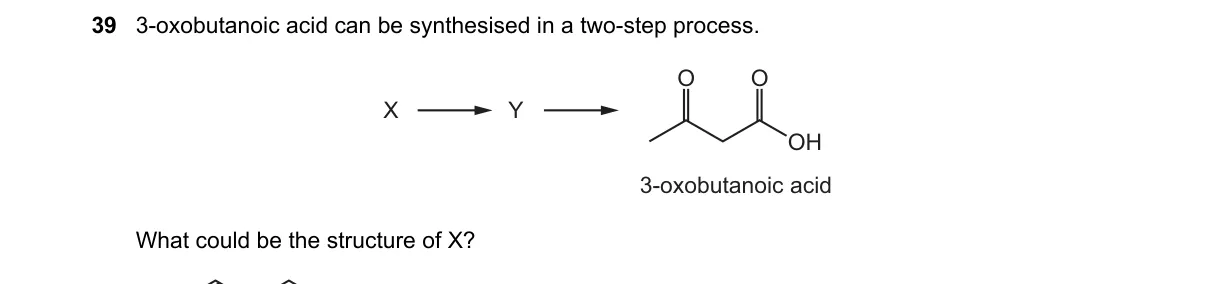
- X, ethyl acetate (CH₃COOCH₂CH₃), undergoes base-catalyzed Claisen condensation with another molecule of itself to form Y, ethyl 3-oxobutanoate (CH₃COCH₂COOCH₂CH₃).
- Y undergoes acid hydrolysis to yield 3-oxobutanoic acid (CH₃COCH₂COOH), the beta-keto acid product.
- The reaction sequence relies on the enolate formation from the alpha-hydrogen of ethyl acetate, followed by nucleophilic attack on the carbonyl.
- Mild hydrolysis conditions prevent decarboxylation, isolating the target acid.
Why A is correct:
- A depicts ethyl acetate, the standard self-condensing ester in Claisen reaction to generate the required beta-keto ester intermediate per organic synthesis principles.
Why the others are wrong:
- B (acetone) lacks ester functionality for Claisen condensation and cannot form the beta-keto ester.
- C (ethanol) is an alcohol, not a carbonyl compound suitable for enolate formation or condensation.
- D (acetic acid) is a carboxylic acid that does not undergo Claisen under basic conditions without esterification first.
Final answer: A
Topic: Organic synthesis
Practice more A Levels Chemistry (9701) questions on mMCQ.me