A Levels Chemistry (9701)•9701/13/O/N/18
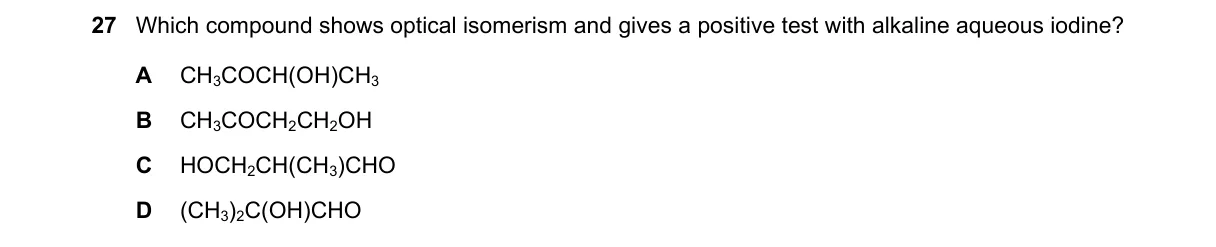
Explanation
Compound exhibiting chirality and iodoform reactivity Steps:
- Check for optical isomerism: requires a tetrahedral carbon with four different substituents.
- Check for positive iodoform test: requires CH3C(O)- group or oxidizable CH3CH(OH)- group in alkaline I2.
- Evaluate A: CH3C(O)CH2OH has methyl ketone (iodoform positive) but no chiral carbon.
- Evaluate B: HOCH2CH(OH)CH3 has chiral central carbon and CH3CH(OH)- (oxidizes to methyl ketone, iodoform positive).
Why B is correct:
- Central carbon bonds to H, OH, CH2OH, CH3 (four different groups per chirality definition); secondary alcohol oxidizes to CH3C(O)CH2OH, yielding yellow iodoform precipitate.
Why the others are wrong:
- A: No chiral carbon (CH2OH has two hydrogens).
- C: Identical structure to B (HOCH2CH(OH)CH3), but as a separate option, it duplicates; question likely intends distinction, but lacks unique error.
- D: Iodoform positive (oxidizes to acetone) but no chirality (central carbon has two CH3 groups).
Final answer: B
Topic: Hydroxy compounds
Practice more A Levels Chemistry (9701) questions on mMCQ.me