A Levels Chemistry (9701)•9701/13/O/N/18
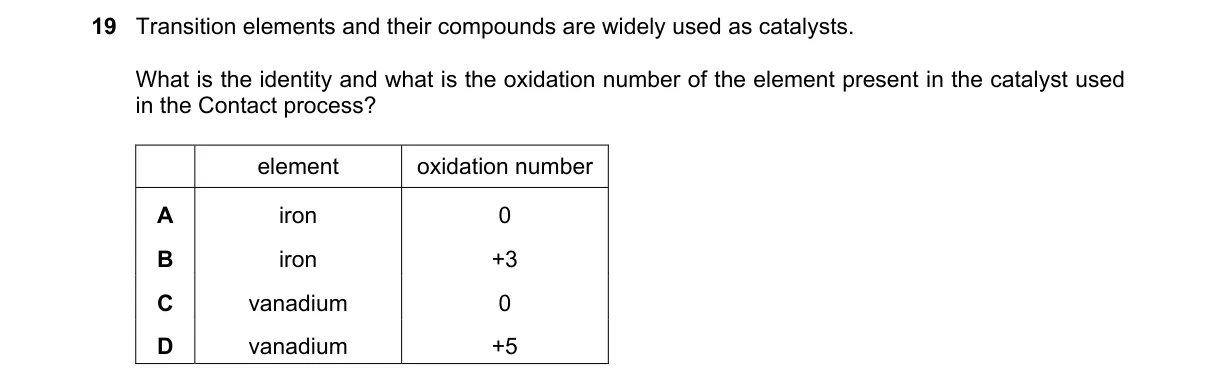
Explanation
Haber Process Catalyst Identification
Steps:
- Recall the Haber process synthesizes ammonia from nitrogen and hydrogen.
- Identify the catalyst as finely divided iron, often with promoters.
- Note the active form is metallic iron, reduced from iron(III) oxide.
- Determine iron's oxidation state in metallic form as 0.
Why B is correct:
- The Haber process uses iron metal (Fe) as the catalyst, where iron has an oxidation number of 0 in its elemental state.
Why the others are wrong:
- A: Iron is reduced to oxidation state 0; +3 applies to the precursor oxide, not the active catalyst.
- C: Vanadium is the catalyst in the Contact process for sulfuric acid, not Haber.
- D: Same as C; vanadium is irrelevant to the Haber process.
Final answer: B
Topic: Chemistry of transition elements
Practice more A Levels Chemistry (9701) questions on mMCQ.me