A Levels Chemistry (9701)•9701/12/O/N/18
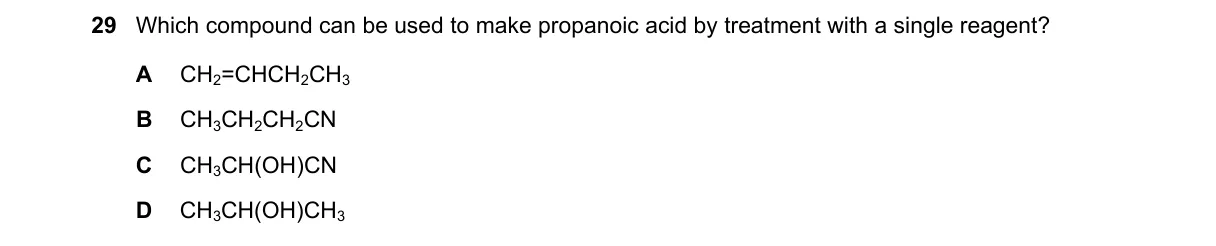
Explanation
Nitriles hydrolyze to carboxylic acids with one reagent
Steps:
- Propanoic acid is CH3CH2COOH, requiring a precursor that adds COOH via single treatment.
- CH3CH2CN (propanenitrile) matches the carbon chain and converts directly via hydrolysis.
- CH3CH2CH2Br (1-bromopropane) needs two steps: substitution to nitrile, then hydrolysis.
- CH3CH(OH)CH3 (propan-2-ol) oxidizes to ketone, not acid.
- CH3CH2OCH3 (methoxyethane) cleaves to alcohols, not acid.
Why A is correct:
- Nitriles react with H2O and one reagent (e.g., HCl) to form RCOOH + NH4Cl, where R=CH3CH2.
Why the others are wrong:
- B requires CN⁻ substitution first, then hydrolysis—two reagents.
- C oxidizes with KMnO4 to (CH3)2C=O, a ketone.
- D undergoes HI cleavage to CH3CH2OH and CH3I, alcohols.
Final answer: A
Topic: Carboxylic acids and derivatives
Practice more A Levels Chemistry (9701) questions on mMCQ.me