A Levels Chemistry (9701)•9701/12/O/N/18
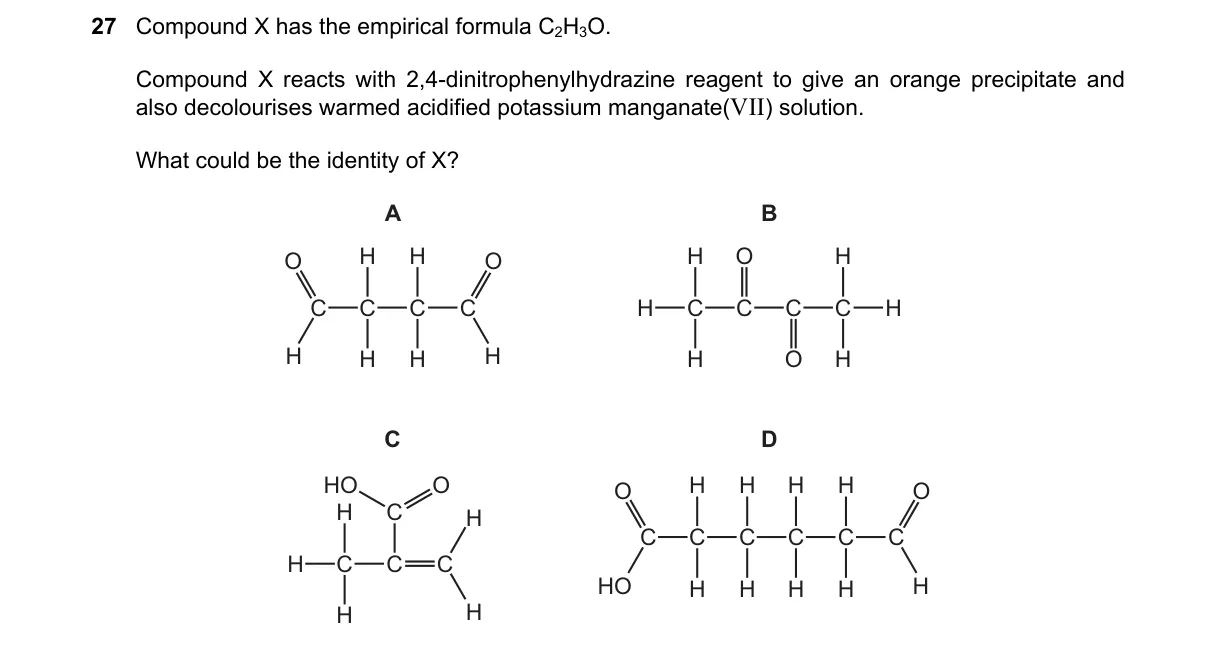
Explanation
Identifying carbonyl compound via chemical tests and empirical formula
Steps:
- Orange precipitate with 2,4-DNPH indicates a carbonyl group (aldehyde or ketone).
- Decolourisation of warm acidified KMnO4 shows the compound is oxidisable, consistent with an aldehyde.
- Empirical formula C2H4O has one degree of unsaturation, matching a simple aldehyde like ethanal (CH3CHO).
- Ethanal fits both tests: forms hydrazone with DNPH and oxidises to ethanoic acid with KMnO4.
Why A is correct:
- A is ethanal (CH3CHO), an aldehyde that reacts with DNPH to form an orange precipitate and reduces KMnO4 due to its aldehydic hydrogen.
Why the others are wrong:
- B (oxirane) lacks a carbonyl, so no DNPH reaction.
- C (ethenol) is unstable and tautomerises to ethanal, not a distinct compound.
- D (ethanal hydrate) has formula C2H6O2, not matching C2H4O.
Final answer: A
Topic: Carbonyl compounds
Practice more A Levels Chemistry (9701) questions on mMCQ.me