A Levels Chemistry (9701)•9701/12/O/N/18
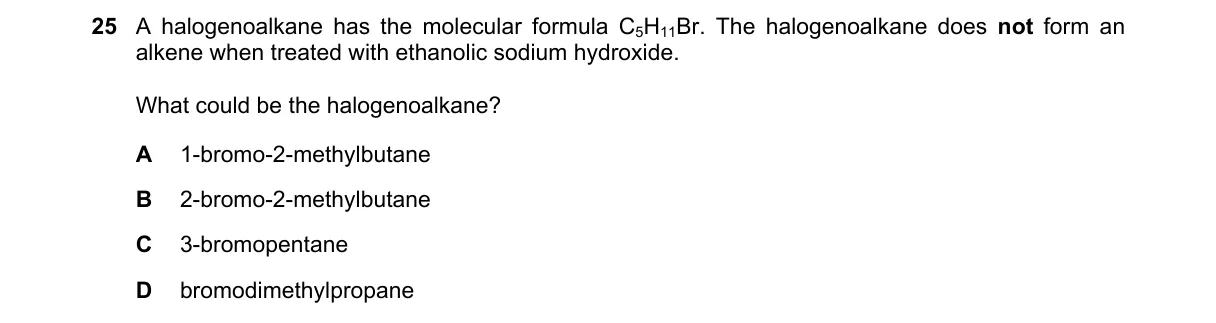
Explanation
Ethanolic NaOH promotes elimination in 2°/3° haloalkanes but substitution in unhindered 1° ones
Steps:
- Classify options: A (primary, beta-branched), B (tertiary), C (secondary), D (primary, unhindered).
- Recall ethanolic NaOH mechanism: 2°/3° favor E2 elimination forming alkenes; unhindered 1° favor SN2 substitution forming ethers.
- Note beta-branching in 1° haloalkanes sterically hinders SN2, allowing E2 competition.
- Select D as unhindered primary, which resists elimination.
Why D is correct:
- 1-Bromobutane is an unhindered primary haloalkane; by SN2 mechanism, it forms 1-ethoxybutane via substitution, not alkene via elimination.
Why the others are wrong:
- A: Beta-branched primary; hindrance favors E2 to 2-methylpropene.
- B: Tertiary; E2 rapidly forms 2-methylpropene.
- C: Secondary; E2 forms but-1-ene and but-2-ene.
Final answer: D
Topic: Halogen compounds
Practice more A Levels Chemistry (9701) questions on mMCQ.me