A Levels Chemistry (9701)•9701/11/O/N/18
Explanation
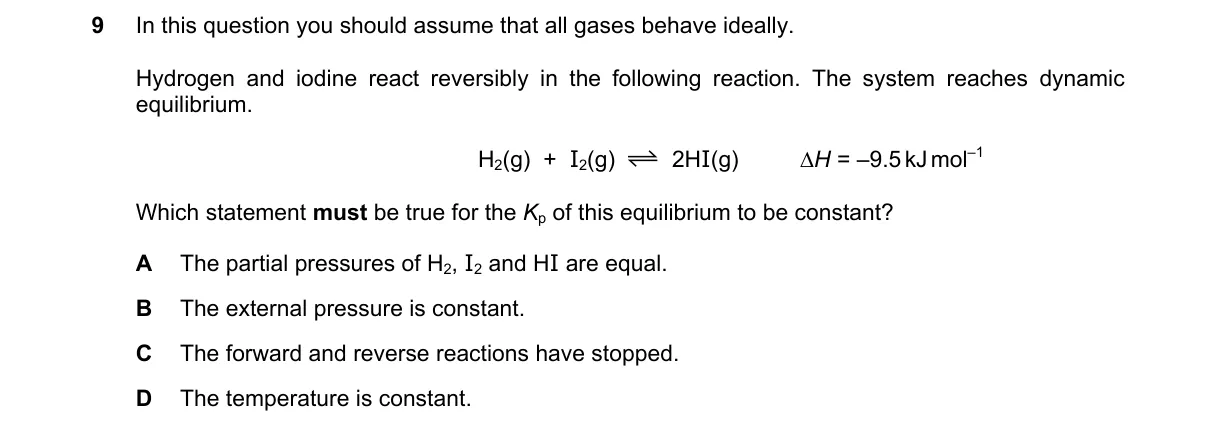
K_p is constant only at constant temperature
Steps:
- K_p is defined as K_p = (P_HI)^2 / (P_H2 * P_I2) at equilibrium.
- This ratio remains constant for a given reaction under ideal gas conditions.
- The value of K_p varies with temperature, as shown by the van't Hoff equation.
- Thus, constant temperature is required for K_p to be fixed.
Why D is correct:
- K_p depends on temperature via ΔH in the van't Hoff equation: ln(K_p) = -ΔH/RT + constant, so T must be constant for K_p to hold a specific value.
Why the others are wrong:
- A: Partial pressures satisfy the K_p expression but are not required to be equal.
- B: Total pressure can change at constant T without altering K_p for this Δn=0 reaction.
- C: Equilibrium means equal forward and reverse rates, not stopped reactions.
Final answer: D
Topic: Equilibria
Practice more A Levels Chemistry (9701) questions on mMCQ.me