A Levels Chemistry (9701)•9701/11/O/N/18
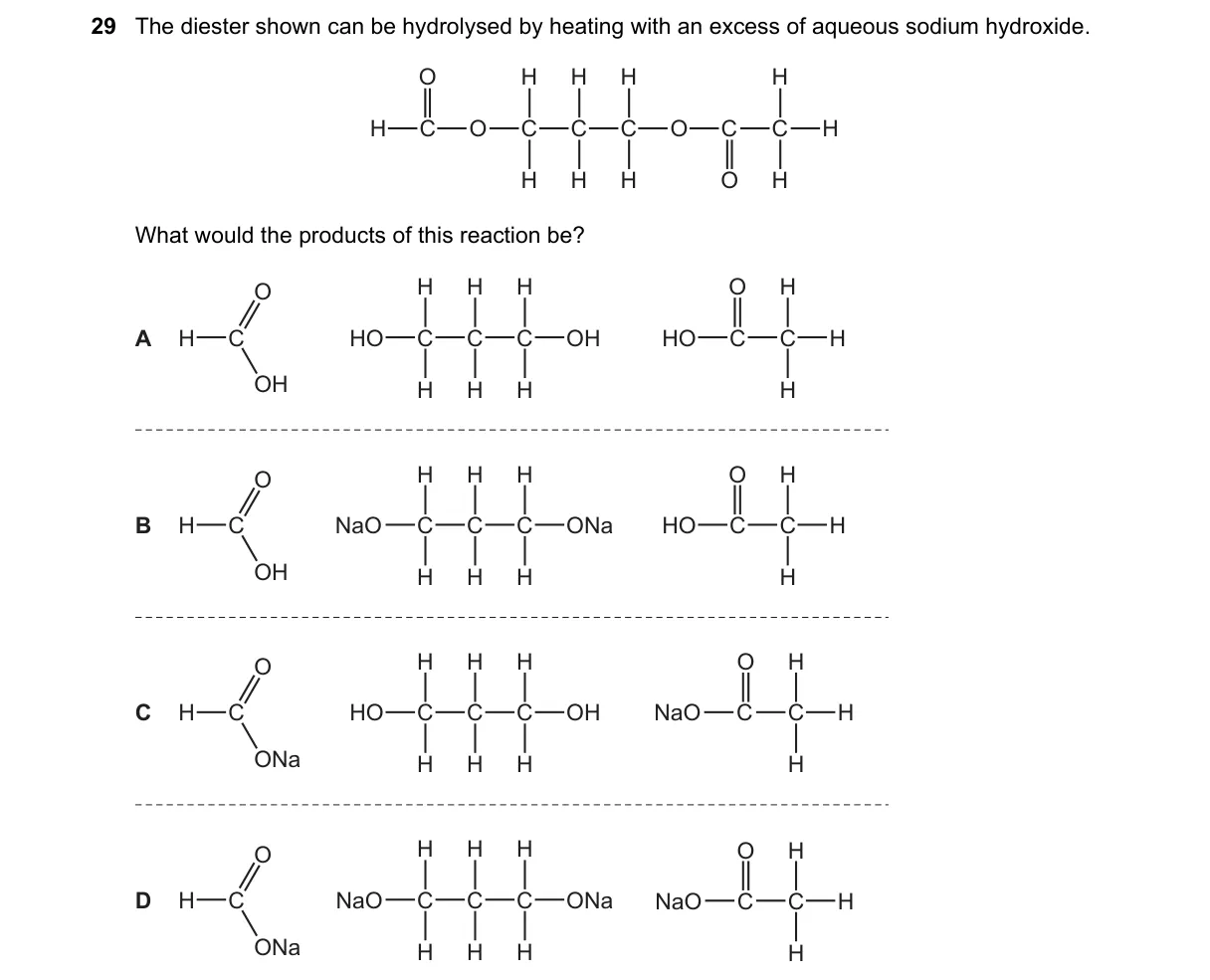
Explanation
Diester saponification under basic hydrolysis
Steps:
- Diester undergoes nucleophilic acyl substitution with OH⁻ from NaOH, cleaving each ester to form carboxylate and alcohol.
- Excess aqueous NaOH ensures complete hydrolysis of both ester groups.
- Products are sodium carboxylates (salts) and alcohols; no acidic workup, so salts remain.
- For a typical diester like ROOC-(CH₂)ₙ-COOR, yields ⁻OOC-(CH₂)ₙ-COO⁻ 2Na⁺ and 2 ROH.
Why C is correct:
- C shows the dianionic dicarboxylate salt and two alcohol molecules, matching basic hydrolysis products per saponification definition.
Why the others are wrong:
- A: Shows diacid, requiring acidic workup not present.
- B: Shows monoester, implying incomplete hydrolysis despite excess base.
- D: Includes unchanged ester, ignoring full reaction conditions.
Final answer: C
Topic: Carboxylic acids and derivatives
Practice more A Levels Chemistry (9701) questions on mMCQ.me