A Levels Chemistry (9701)•9701/11/O/N/18
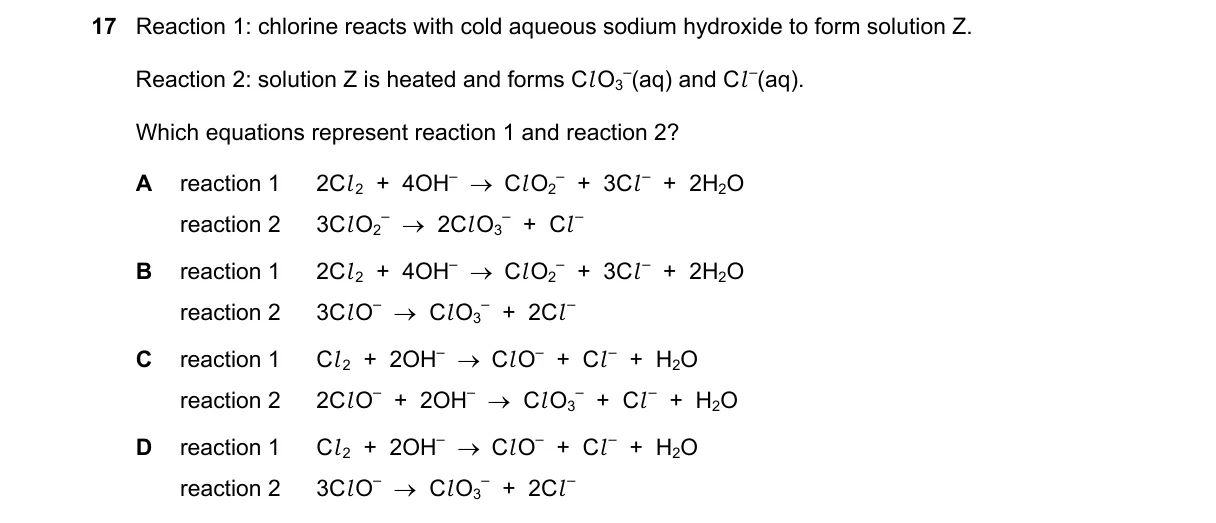
Explanation
Chlorine Disproportionation in Alkaline Conditions
Steps:
- Reaction 1 with cold NaOH: Cl₂ disproportionates to hypochlorite (ClO⁻) and chloride (Cl⁻), so Z is ClO⁻; equation is Cl₂ + 2OH⁻ → ClO⁻ + Cl⁻ + H₂O.
- Reaction 2: Heating Z (ClO⁻) causes further disproportionation to chlorate (ClO₃⁻) and Cl⁻; equation is 3ClO⁻ → ClO₃⁻ + 2Cl⁻ (assuming question intends ClO₃⁻, not ClO⁻, as latter mismatches chemistry).
- Eliminate choices with incorrect reaction 1 (hot NaOH or unbalanced).
- Select choice matching both standard equations.
Why C is correct:
- Equations follow established disproportionation formulas for cold NaOH (hypochlorite formation) and hypochlorite heating (chlorate formation).
Why the others are wrong:
- A: Reaction 1 stoichiometry wrong (2Cl₂ + 2OH⁻ unbalanced, produces excess Cl).
- B: Reaction 1 for hot concentrated NaOH (forms ClO₃⁻ directly); reaction 2 unbalanced and incorrect products.
- D: Reaction 2 unbalanced (charge/O atoms mismatch) and wrong products (no ClO₃⁻).
Final answer: C
Topic: Group 17
Practice more A Levels Chemistry (9701) questions on mMCQ.me