A Levels Chemistry (9701)•9701/11/O/N/18
Explanation
Bonding and Structures of Silicon Oxides and Chlorides
Steps:
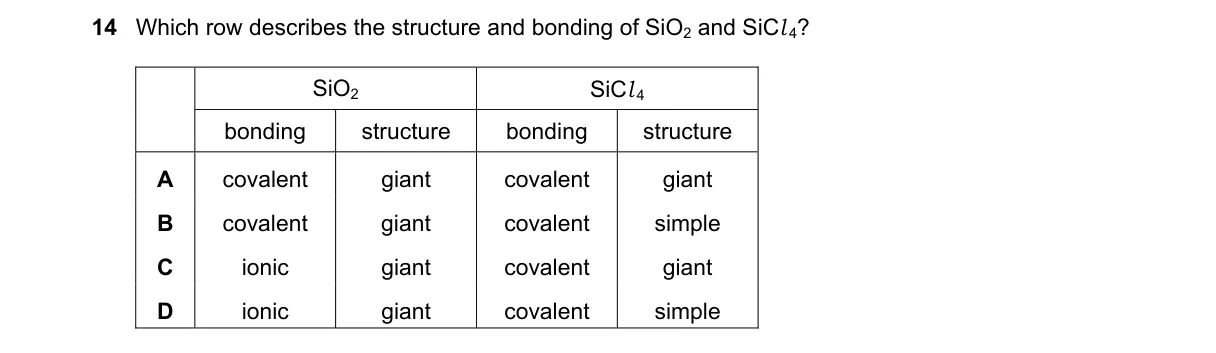
- SiO₂ bonding is covalent due to moderate electronegativity difference (Si 1.8, O 3.5), forming strong Si-O bonds.
- SiO₂ structure is giant covalent lattice, with each Si tetrahedrally bonded to 4 O atoms in a 3D network.
- SiCl₄ bonding is covalent, as Si shares electrons with 4 Cl atoms in discrete tetrahedral molecules.
- SiCl₄ structure is simple molecular, with molecules held by weak intermolecular forces.
Why B is correct:
- B accurately classifies SiO₂ as covalent giant (network solid) and SiCl₄ as covalent simple (molecular compound), aligning with Fajans' rules for polarization in silicon compounds.
Why the others are wrong:
- A: Erroneously gives SiCl₄ a giant structure; it is discrete molecules, not a lattice.
- C: Incorrectly assigns ionic bonding to SiO₂; electronegativity favors covalent character.
- D: Falsely labels SiO₂ bonding as ionic, ignoring its covalent network.
Final answer: B
Topic: Chemical bonding
Practice more A Levels Chemistry (9701) questions on mMCQ.me