A Levels Chemistry (9701)•9701/14/M/J/25
Explanation
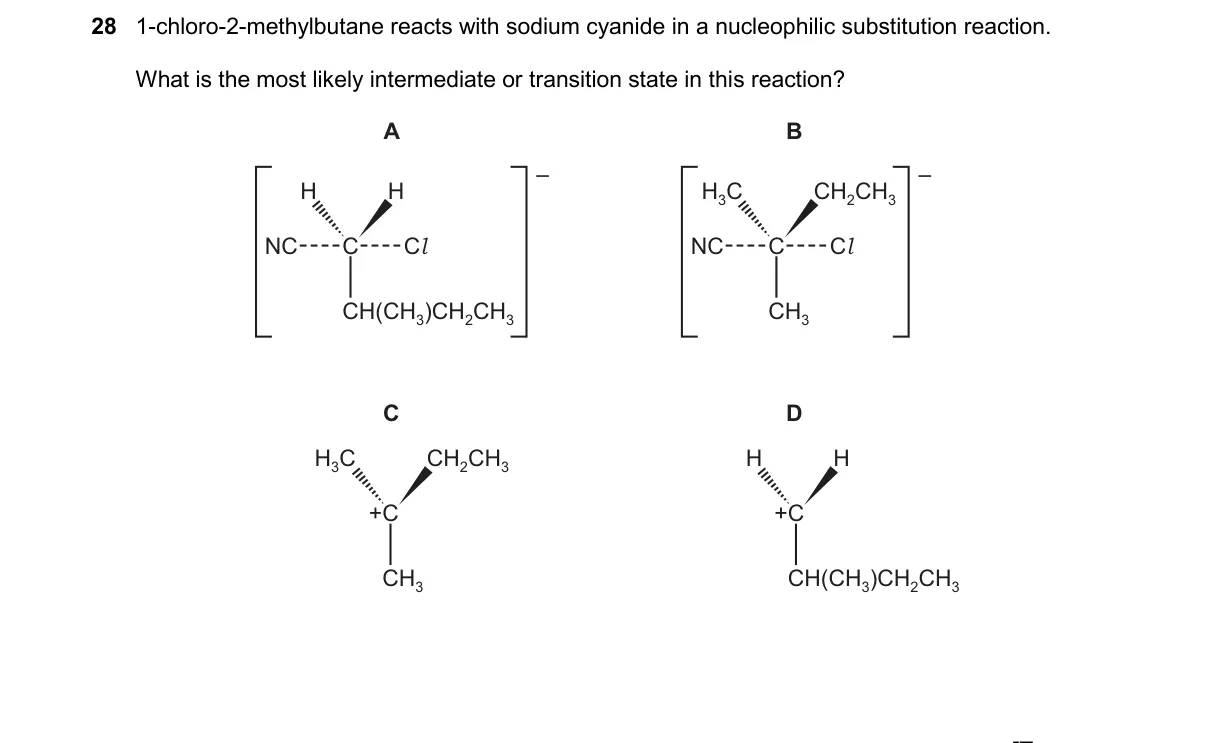
SN2 Transition State in Primary Alkyl Halide Substitution
Steps:
- Identify the substrate: 1-chloro-2-methylbutane is a primary alkyl chloride with beta branching.
- Assess reaction conditions: NaCN provides CN⁻, a strong nucleophile, favoring bimolecular substitution.
- Predict mechanism: Primary halides undergo SN2, not SN1, due to low carbocation stability.
- Determine key feature: SN2 involves a single transition state with partial bonds to entering group and leaving group.
Why A is correct:
- A depicts the SN2 transition state, a trigonal bipyramidal structure with simultaneous CN⁻ approach and Cl⁻ departure, per the SN2 mechanism definition.
Why the others are wrong:
- B shows a carbocation intermediate, characteristic of SN1 but unlikely for primary halides.
- C represents an SN1 transition state, which requires rate-determining carbocation formation absent here.
- D illustrates an SNi or frontside attack, not favored in SN2 due to steric and electronic factors.
Final answer: A
Topic: Halogen compounds
Practice more A Levels Chemistry (9701) questions on mMCQ.me