Explanation
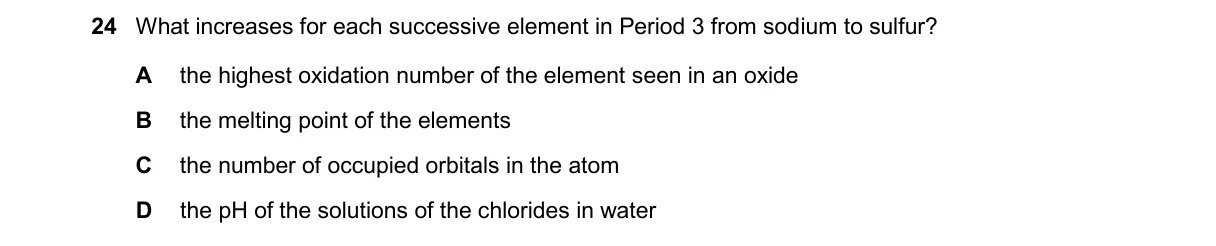
Increasing maximum oxidation state in Period 3 oxides Steps: - Identify Period 3 elements from Na (group 1) to S (group 16), focusing on trends in atomic structure and bonding. - Examine oxidation numbers in oxides: Na (+1 in Na₂O), Mg (+2 in MgO), Al (+3 in Al₂O₃), Si (+4 in SiO₂), P (+5 in P₄O₁₀), S (+6 in SO₃). - Confirm steady increase from +1 to +6 due to rising group number and valence electrons available for bonding. - Compare to other options: melting points fluctuate (e.g., Si highest, then drop); occupied orbitals remain consistent (1s, 2s/2p, 3s/3p shells); chloride pH varies but trends acidic, lowering pH. Why A is correct: - Maximum oxidation state equals group number for p-block elements, per octet rule, allowing more oxygen bonds as valence electrons increase. Why the others are wrong: - B: Melting points rise to Si then fall sharply for P and S due to bonding type shifts (metallic to molecular). - C: All elements share the same occupied subshells (up to 3p), with electrons added but no new orbitals. - …
Practice more A Levels Chemistry (9701) questions on mMCQ.me