A Levels Chemistry (9701)•9701/14/M/J/25
Explanation
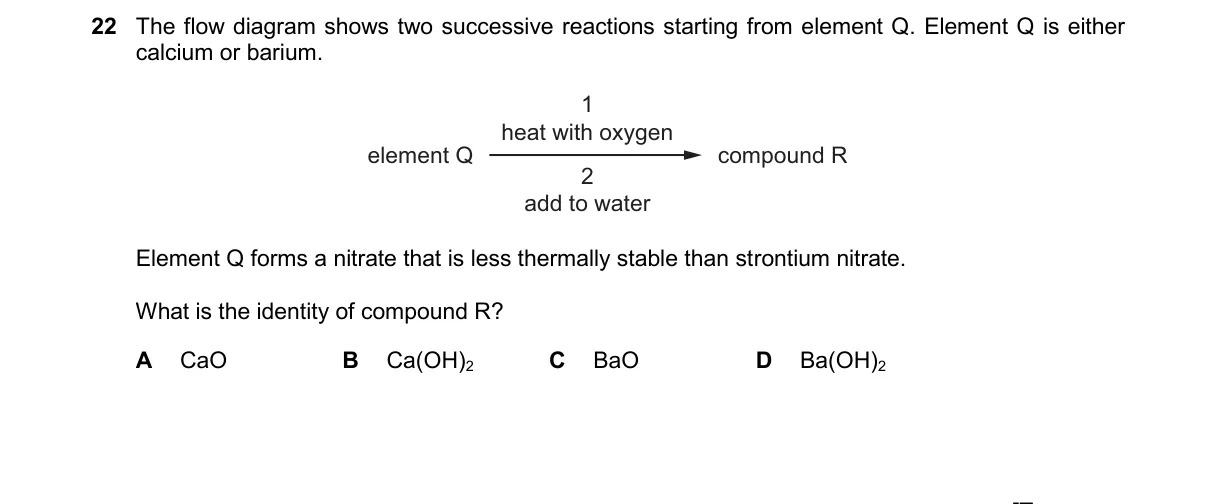
Nitrate thermal stability identifies Q as calcium; R is the hydroxide from successive reactions.
Steps:
- Group 2 nitrates increase in thermal stability down the group: Ca(NO₃)₂ decomposes below Sr(NO₃)₂, while Ba(NO₃)₂ is more stable.
- Q forms a nitrate less stable than Sr(NO₃)₂, so Q is calcium.
- Flow diagram: first reaction is Q + O₂ → QO (oxide formation).
- Second reaction: QO + H₂O → Q(OH)₂, so R is Ca(OH)₂.
Why B is correct:
- Ca(OH)₂ forms via CaO + H₂O → Ca(OH)₂, the standard reaction for Group 2 oxides with water.
Why the others are wrong:
- A. CaO is the intermediate from the first reaction, not R.
- C. BaO is barium oxide, but Q is calcium.
- D. Ba(OH)₂ is barium hydroxide, but Q is calcium.
Final answer: B
Topic: Group 2
Practice more A Levels Chemistry (9701) questions on mMCQ.me