A Levels Chemistry (9701)•9701/12/M/J/25
Explanation
Dehydration of propan-1-ol yields propene, which undergoes electrophilic addition with Br2.
Steps:
- Propan-1-ol (CH3CH2CH2OH) dehydrates over Al2O3 to form propene (CH3CH=CH2) via loss of water.
- Propene reacts with Br2 in anti-Markovnikov fashion? No, it's symmetrical addition across the double bond.
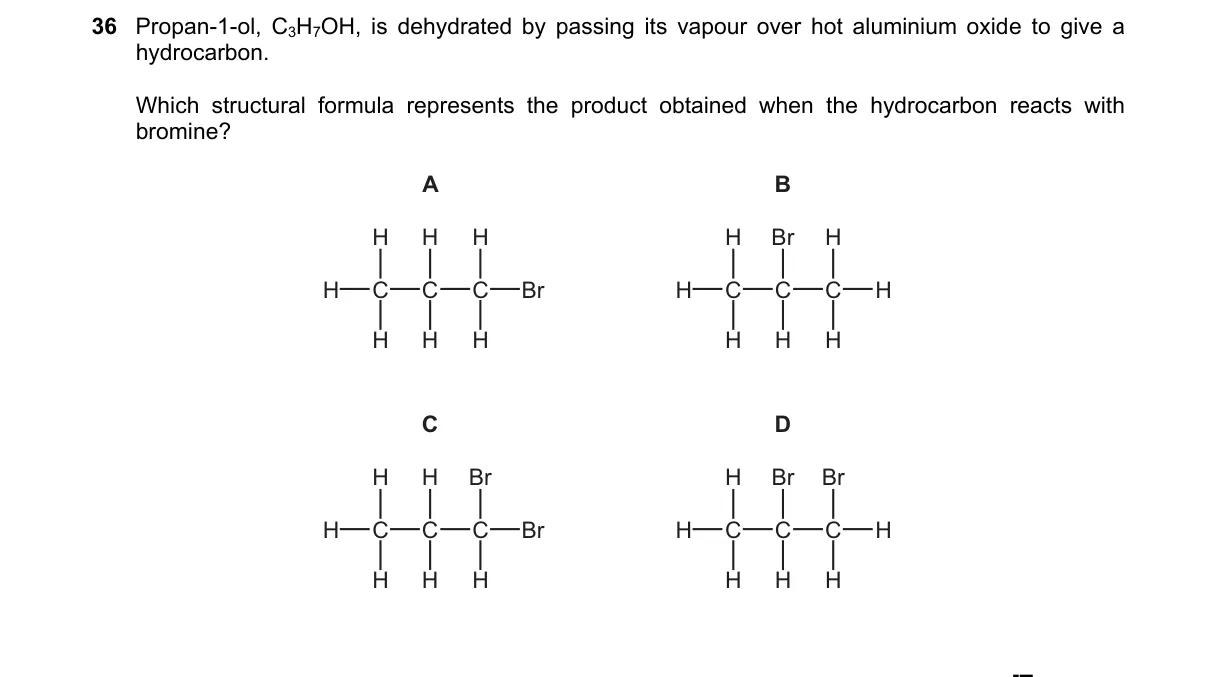
- The product is 1,2-dibromopropane (CH3CHBrCH2Br), a vicinal dibromide.
- Match the structural formula showing Br on adjacent carbons in a three-carbon chain.
Why D is correct:
- D depicts CH3-CHBr-CH2Br, matching the addition product formula from alkene + Br2, following Markovnikov's rule for unsymmetrical alkenes.
Why the others are wrong:
- A shows monobromopropane (CH3CH2CH2Br), a substitution product, not addition.
- B shows 2-bromopropane (CH3CHBrCH3), incorrect regiochemistry for propene addition.
- C shows a geminal dibromide (CH3CBr2CH3), violating anti addition mechanism.
Final answer: D
Topic: Hydrocarbons
Practice more A Levels Chemistry (9701) questions on mMCQ.me