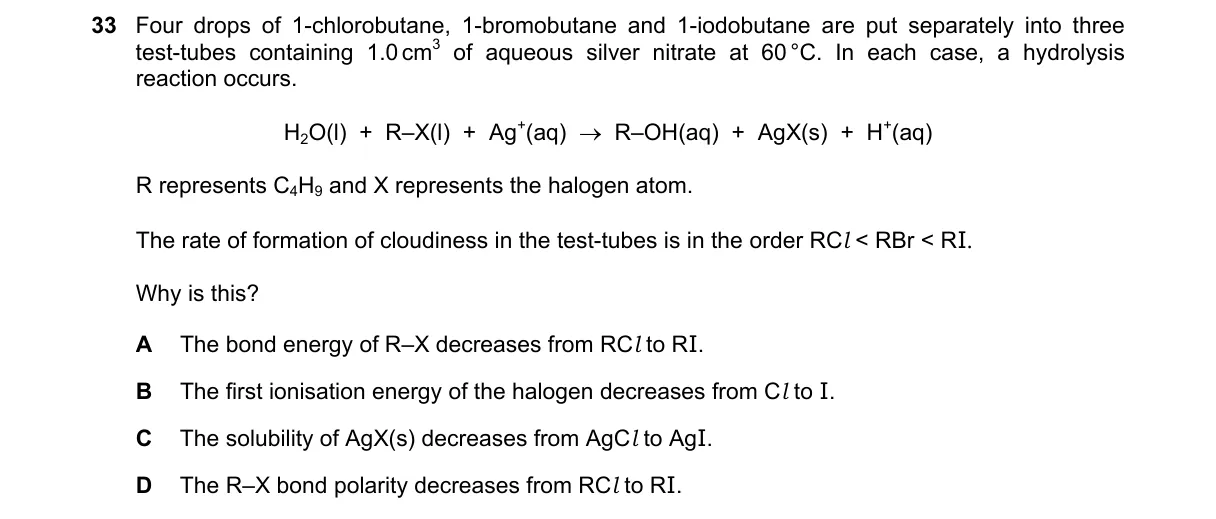
Explanation
Decreasing C-X bond strength speeds up SN1 ionization Steps: - Hydrolysis of R-X with aqueous AgNO3 at 60°C proceeds via SN1 mechanism, forming R⁺ and X⁻. - Ag⁺ immediately precipitates X⁻ as AgX, producing cloudiness. - Rate-determining step is heterolytic cleavage of C-X bond to generate X⁻. - Bond strength decreases from C-Cl to C-I, accelerating ionization and cloudiness for RI > RBr > RCl. Why B is correct: - Bond energy of R-X decreases from Cl to I due to increasing atomic size and poorer p-orbital overlap, weakening the bond (e.g., BDE: C-Cl 351 kJ/mol > C-Br 293 kJ/mol > C-I 234 kJ/mol for methyl analogs), easing departure of X⁻ in SN1. Why the others are wrong: - A: First ionization energy decrease (Cl > Br > I) affects halogen atom electron removal, irrelevant to X⁻ leaving group formation. - C: Decreasing AgX solubility (AgCl > AgBr > AgI) aids precipitation but does not determine the ionization rate order. - D: R-X polarity increases from I to Cl (higher Cl electronegativity), but SN1 favors bond weakness over polarity. Final …
Practice more A Levels Chemistry (9701) questions on mMCQ.me