A Levels Chemistry (9701)•9701/12/M/J/25
Explanation
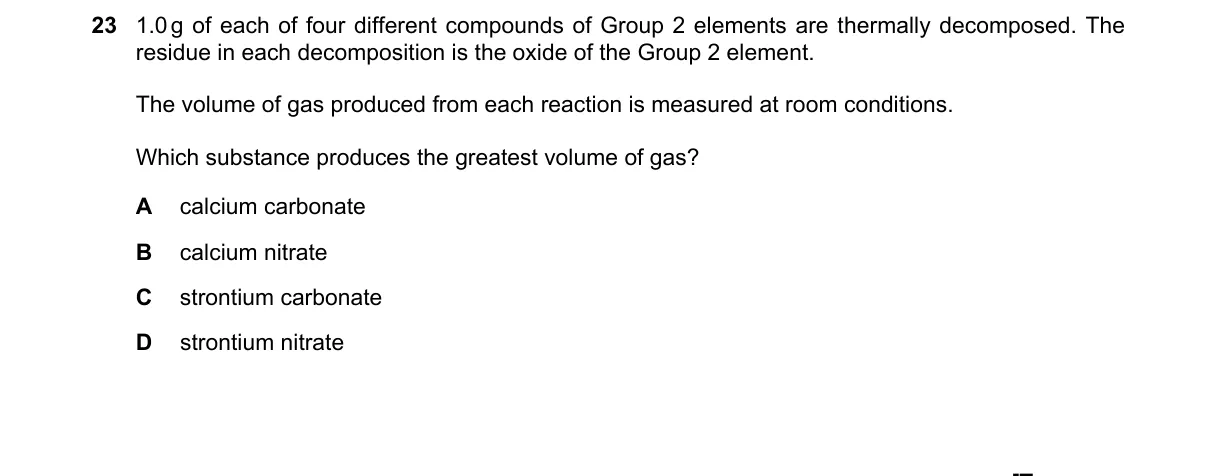
Gas volume depends on moles of gas released per gram of compound Steps:
- Determine decomposition reactions: carbonates yield 1 mol CO₂ per mol; nitrates yield 2.5 mol gas (2NO₂ + ½O₂) per mol.
- Calculate molar masses: CaCO₃ ≈100 g/mol, SrCO₃ ≈148 g/mol, Ca(NO₃)₂ ≈164 g/mol, Sr(NO₃)₂ ≈212 g/mol.
- Compute moles of gas per gram: CaCO₃ (1/100=0.010), SrCO₃ (1/148≈0.0068), Ca(NO₃)₂ (2.5/164≈0.015), Sr(NO₃)₂ (2.5/212≈0.012).
- Compare: Ca(NO₃)₂ produces the most moles of gas per gram, hence greatest volume at room conditions.
Why C is correct:
- Calcium nitrate has the lowest molar mass for a nitrate, maximizing moles of compound (and thus 2.5 mol gas) per gram, per ideal gas law (V ∝ n).
Why the others are wrong:
- A: Calcium carbonate yields only 1 mol gas/mol, less than nitrates' 2.5.
- B: Strontium nitrate yields 2.5 mol gas/mol but higher molar mass reduces moles per gram vs. calcium nitrate.
- D: Strontium carbonate yields 1 mol gas/mol and highest molar mass, minimizing gas per gram.
Final answer: C
Topic: Group 2
Practice more A Levels Chemistry (9701) questions on mMCQ.me