A Levels Chemistry (9701)•9701/12/M/J/25
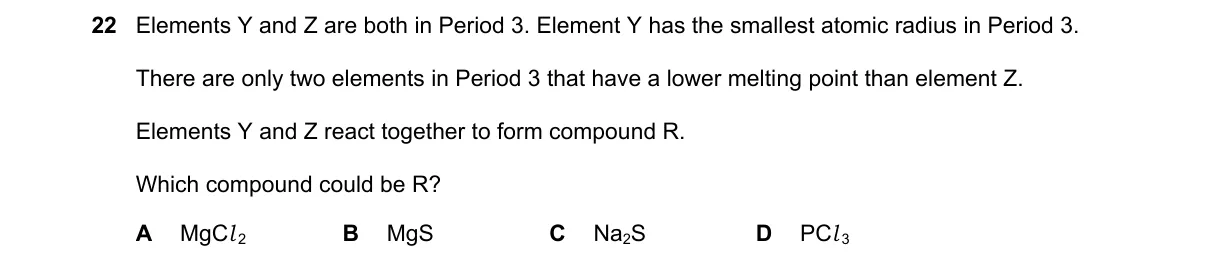
Explanation
Y is Cl (smallest Period 3 radius); forms low-mp PCl₃ with Z=P.
Steps:
- Y=Cl due to smallest atomic radius in Period 3 (decreases left to right).
- Z=another Period 3 element; R=their compound with mp < Z's mp.
- Options must include Cl (Y) and Period 3 Z.
- Verify mp data: PCl₃ (-93°C) < P (44°C); others fail.
Why D is correct:
- PCl₃ forms from P (Z) and Cl (Y); covalent molecular structure yields low mp (-93°C) below P's (44°C) per intermolecular forces.
Why the others are wrong:
- A: MgCl₂ mp (714°C) > Mg mp (649°C); ionic lattice gives higher mp.
- B: No Cl, so Y cannot be Cl with smallest radius.
- C: No Cl, so Y cannot be Cl with smallest radius.
Final answer: D
Topic: The Periodic Table: chemical periodicity
Practice more A Levels Chemistry (9701) questions on mMCQ.me