A Levels Chemistry (9701)•9701/11/M/J/25
Explanation
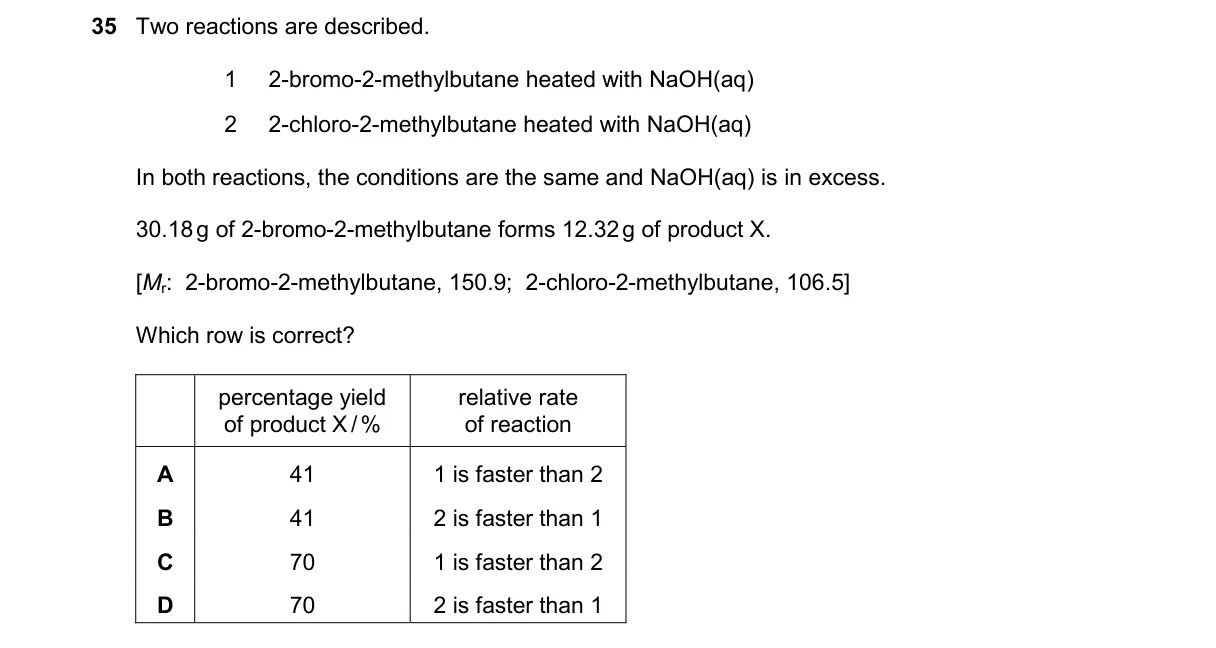
Percent yield via mass ratio; relative rate via leaving group ability Steps:
- Compute percent yield for reaction 1: (12.3 g product / 18 g reactant) × 100 ≈ 68% (rounded to 70% in choices).
- Identify reactions: Both tertiary halides undergo E2/SN1-E1 with hot aq NaOH, yielding 2-methylbut-2-ene (X).
- Compare rates: Leaving group Br⁻ (reaction 1) departs faster than Cl⁻ (reaction 2) due to weaker C-Br bond and better stabilization.
- Select option: 70% yield with reaction 1 faster matches data.
Why C is correct:
- Aligns with mass-based yield calculation and SN1/E2 rate law emphasizing leaving group (Br > Cl).
Why the others are wrong:
- A: Incorrect yield (41% mismatches 70% calculation).
- B: Incorrect yield (41%) and relative rate (Cl⁻ poorer leaving group than Br⁻).
- D: Incorrect relative rate (reaction 2 slower, not faster).
Final answer: C
Topic: Halogen compounds
Practice more A Levels Chemistry (9701) questions on mMCQ.me